Sunday, April 02, 2017

Sahayak sting: The Army has a few questions to answer – but so does the media

Published in Scroll.in

Should the media discuss the question of ethics and sting operations when a journalist has been slapped with a draconian law like the Official Secrets Act? Or will such a discussion undermine the position of a journalist who was trying to unearth a story?

In my view, these are not mutually exclusive choices. So even as the Army’s response in the case involving the expose of the sahayak system is unwarranted, I believe some introspection by the media on the means used to expose certain stories should also be discussed.

On March 28, the Nashik police filed a First Information Report against Poonam Agarwal, associate editor, investigations, of The Quint, a news website, based on a complaint it received from the Army. This was in response to Agarwal’s story of February 24, exposing the sahayak or orderly system that continues to operate in the Army despite the recommendation of the Parliamentary Standing Committee on Defence that it be scrapped.

Under this system, soldiers are assigned to senior Army officers and are expected to assist them. Such assistance, however, has been extended to getting these men to do all kinds of personal and even menial jobs.


The investigation


Agarwal says she got the idea for the story when Lance Nayak Yagya Pratap Singh posted a video on his Facebook page on January 13 complaining about the sahayak system. Agarwal established contacts that led her to the Deolali cantonment of the Indian Army in Maharashtra’s Nashik district.

Using a hidden camera, she recorded the testimonies of some of these sahayaks. Her report and video were published on February 24. Three days later, she sent the link to the Army with an email asking questions about the sahayak system and whether the Army intended to end it as recommended by the parliamentary committee.

The Army public relations officer, Aman Anand, responded to each of her questions and explained that the sahayak system was “an instrument of team building”. He also wrote that any “ill treatment” of a subordinate was an offence under the Army Act.

This exchange took place a few days before the body of Lance Naik Roy Mathew, one of the men Agarwal had interviewed, was found hanging in an abandoned shed in the cantonment. It was suspected he had committed suicide although his family has alleged foul play.

Since then, there have been several developments leading up to the FIR against Agarwal, but not against the senior editors of the website that employs her who would have cleared her story.


Inconsistencies by Army


One of the major inconsistencies in statements by the Army, and the complainant, on the basis of which the FIR was lodged, was whether the identities of the men interviewed were exposed in the video. Agarwal has stated that their identity had been adequately masked. The Ministry of Defence, in a press release dated March 3, reiterates this and states:

“The identities of the Army personnel involved in the clipping was hidden, and thereby not known to the Army. Hence, there is no question of any inquiry that could have been ordered against the deceased.”

Yet, Lance Naik Naresh Kumar Amitchand Jatav, who filed the police complaint about Agarwal on March 27, and acknowledges that he is a sahayak, says that he was summoned by senior officers on February 25, a day after the video was published on The Quint’s website.

He says he saw the video on February 24 and that his face was blurred in it. Therefore, if the Army did not know the identities of the men in the video, why was Jatav summoned? Was Roy Mathew also similarly summoned?

Jatav says the officers admonished him but let him go. But in the course of the questioning, they got him to reveal who facilitated Agarwal’s entry into the campus. According to the complaint, she came with a Kargil war veteran, Deep Chand, who introduced her to the soldiers as his relative.

The details of this entire episode appear here and here.

The video that ostensibly led to all this was taken off The Quint’s website following Roy’s suicide, and this writer has not seen it.


A few questions


While this case will continue to unravel, it is already evident that there are many unanswered questions. But given the iron wall built around the armed forces, and the ultra-nationalist hype that dominates the public discourse in India today, any questions about the Army and its conduct will be predictably be dubbed as “anti-national”. We might never know the full truth.

Still, there are a couple of questions that the Army needs to answer.
First, why has the Army reacted in this way by using the Official Secrets Act, one of the most draconian laws, against a journalist? After all, the sahayak system is not a state secret. It is already under scrutiny.

Second, how did the officers in Deolali know which men had spoken to Agarwal if, on its own admission, the Army accepts that their identities were blurred in the video? Did it question other sahayaks, apart from Jatav who filed the complaint? How would we know whether these men were threatened with a court martial or some other punishment?


Media ethics


At the same time, there are some other questions that need to be addressed by the media in general and The Quint in particular.

Some in the media have justified the use of hidden cameras and recorders saying that this was the only way to expose the powerful. Some of the instances cited to support the claim are Operation West End, the sting operation carried out by Tehelka magazine in 2001, exposing defence deals and the nexus with politicians, as well as journalist-turned-politician Ashish Khetan’s sting on former Gujarat minister Maya Kodnani and Babu Bajrangi that established their role in the 2002 Gujarat massacre.

However, this type of journalism, if it can even be called that, remains highly debatable, as there have been many major media exposes where such methods have not been used.
What is relevant in this instance is that given the powerlessness of the sahayaks within the Indian Army, is it right to use the sting tactic on them, even if their faces are blurred? In a tightly-monitored space like an Army cantonment, it is unlikely that men who have identified themselves as sahayaks could have escaped being identified.

Also, while Lance Nayak Yagya Pratap Singh, who complained about the sahayak system on his Facebook page, did so knowing the risks, Roy Mathew and the other soldiers who appeared in The Quint’s video, had no idea that they were being filmed. Was getting the story more important than ensuring that they were not penalised?

Even though the Army is powerful, and virtually impossible to penetrate, should the most vulnerable in its ranks be the subjects of a sting operation in order to expose the system? Surely the media must be ultra cautious about using such techniques, whatever the justification, if it means exposing the weak to risks they cannot handle, and that too without their consent.

So even as journalists, especially the Network of Women in Media with which this writer is associated, have rallied behind Agarwal and protested the use of the Official Secrets Act against her, the media needs to question the use of hidden cameras against the powerless.

Thursday, March 30, 2017

40 years since the end of the Emergency

It is now 40 years since the end of the Emergency promulgated by Indira Gandhi on June 26, 1975.  It ended when in the general elections on March 21, 1977, she and the Congress Party were thrown out and the Janata Party won by an overwhelming majority.

It is a time many of us will never forget, especially the night of March 21 when the counting on ballots was taking place.  There were no electronic machines then. Ballots had to be counted physically.  And there were no 24-hour news channels to breathlessly follow the results.  So we could only stand outside counting centres and wait as someone came out and announced who was in the lead.

I remember standing with friends outside my old college, Elphinstone College in Kala Ghoda.  It was the counting centre for south Bombay.  We were all rooting for a man we had never heard of earlier, and most of us had never seen him.  His name was Ratansih Rajda of the Janata Party.  All I remember about him is that he always wore a white safari suit!

The excitment grew as the counting built up to a crescendo late into the evening and Rajda was declared elected!

By then, those of us in newspapers had gathered that there was a Janata wave of sorts through the ticker copy on PTI and UNI.  But the full extent of the victory was only known the next morning, when almost all the votes had been counted.

It is hard to describe the euphoria.  Most of us had not slept at all that night.  People were standing outside all the counting centres.  In south Bombay, people hung around Marine Drive and soon celebrations began.

For many of us, this election was our first where we actually felt involved in the political process.

I was reminded of all this today as Naresh Fernandes, editor of Scroll.in posted an article I wrote about Himmat and the Emergency.  Here's the link for those who did not read it earlier:

https://scroll.in/article/735844/himmat-during-the-emergency-when-the-press-crawled-some-refused-to-even-bend


When a "womel" replaced a "manel"


If all-male panels are called "manels", what should we call an all-woman panel?  Womels? 

People, meaning even well-intentioned men, get irritated when women remind them that it is possible to attempt some kind of gender balance when organising panel discussions on a range of subjects.  But the norm remains virtually unchanged.  If the discussion is about women's issues, children, health, the elderly or other so-called societal issues, there is a preponderance of women on the panel.  But if the topic is politics, business, foreign affairs, defence and even law, women are rare or non-existent.

During the extended election process to five state assemblies that concluded earlier this month on March 11, the majority of commentators on television channels were men.  There were women, some of the regulars.  The anchors were sometimes women.  But the majority on any panel discussing the elections were never women.

No wonder the exception stood out.  And not surprisingly, the person to break the norm was Ravish Kumar of NDTV India, the indefatigable journalist who continues to dare the establishment, break the norms of the dominant forms we see in mainstream television journalism, and yet survives!

On March 9, when all the other television channels were going ballistic over the exit polls, Ravish Kumar hosted a "womel", an all woman panel of journalists who had covered the elections and were experienced political reporters.  The women journalists on the panel were Neha Dixit, independent journalist, Sunita Aron from Hindustan Times, Vandita Mishra from Indian Express, Supriya Sharma from Scroll.in and Poornima Joshi from BusinessLine.

Ravish Kumar deliberately decided to ignore the exit polls and instead drew out these journalists on the issues that faced the electorate in the different states that went to the polls.  The programme was informative, there was no shouting and screaming, no butting in or cutting off the participants.  The anchor gave each person adequate time to make their point.  In the end, the viewer came away with an enhanced understanding of the issues that underline the electoral process and that go beyond just the counting of the votes and the results.

In the last decade and more, scores of women journalists have been covering politics.  Unlike the 1970s and even to some extent the 1980s, no one is surprised today to see women interviewing politicians, covering election rallies, and writing incisive and analytical articles on politics in the print media. 

Yet, on television, although women anchor programmes on politics, and are also reporters, they are still rarely seen as "experts" on the subject.  We have to question this. 

Is it gender blindness on the part of mainstream television channels?  Or are experienced women journalists hesitant about pushing themselves forward even as their male counterparts boast about their contacts and experience, however limited? 

Perhaps it is a combination of the two.  And even if one Ravish Kumar cannot topple dominant norms, his initiative has the potential to do so.

Also posted on NWMI's Gender and Elections Blog.

Monday, March 06, 2017

Erasing history

Here's a small news item that many people would have missed as they browsed their Sunday newspapers looking for more exciting fare.  But it tells you have steadily, and deliberately, the Sangh Parivar is erasing India's history.

The story appeared in the Times of India on March 5, 2017.  In sum it says that a fort, that has been historically established as having been built by the Mughal Emperor Akbar in 1570, and was always known as "Akbar ka Qila" has been renamed by the Bharatiya Janata Party (BJP) government in Rajasthan as "Ajmer ka Qila and Sangralaya". 

How many more such creeping changes are taking place away from the eyes of the media and a public that fails to notice what's happening?


Sunday, February 12, 2017

Elections from a gender perspective

There is a gender angle to elections -- all elections.  A collective of women journalist, the Network of Women in Media, India has set up a blog where we curate and comment on election news from this angle.  It gives fascinating insight not always apparent when you read the news or watch television-- with sole exception of Ravish Kumar's Prime Time on NDTV India.

Here's something I wrote on the civic elections in Nagaland that could not be held on the scheduled date of February 1 because Naga tribal bodies, consisting almost entirely of men, objected to 33 per cent reservation of seats for women, saying it was against their tradition.


https://nwmigenderwatch.wordpress.com/

Why the media fails to "explain" Nagaland


For many people in the rest of India, or the "mainland" as people in the Northeast call it, the current standoff in Nagaland over 33% reservation for women in urban local bodies is puzzling.  There is precious little news about Nagaland on most days.  And when you suddenly read about police firing, deaths, curfew, arson and bandhsytaking place not over the continuing demand for a greater Nagaland, or Nagalim, but over reservation of seats for women in municipal bodies, you have every reason to be puzzled.

This reminds us of our abysmal lack of knowledge about a vast area of India that we dismiss as "the Northeast".  The only news we get from the region is either about insurgency, or about natural disasters. We know next to nothing about the lives of people  -- how ordinary people live, what they eat, their sources of livelihood, whetherthey have adequate water, electricity, or health care.  Furthermore, there is an assumption that women in the entire region are better off than their counterparts elsewhere because people have heard, vaguely, that one tribe in one state in northeast India, the Khasis in Meghalaya, has a matrilineal society

It has to be said, though, that at least this time, some mainstream newspapers have taken the trouble to explain what is happening in Nagaland such as in this piece in Indian Express.  However, the article misses out the mainpoint made in the article mentioned below about the centrality of women's fight for justice and equal rights.

Few clearer pieces have been written about the issues underlying the current crisis in Nagaland than this one by Monalisa Changkijaeditor of Nagaland Page, in the Indian Express.  

Monalisa is a writer, poet, journalist and the only woman editor of a daily newspaper in Nagaland.  She lives in Dimapur.  A beautifully laid out garden leads to her tasteful home that is full of paintings and books.  She has always been outspoken and her newspaper is known for its independent stand on a number of tricky issues in a state where journalists have to tread carefully betweengovernments, state and central, on one side, and the different militant groups on the other.  

The key point she makes in her article is that Nagaland's patriarchal traditional society fears the forces of change that more women in institutions of governance would inevitably unleash.  She writes:

"...the fear is that women would finally have a say in how resources are used and shared in towns, which could then spill over to villages. So far, only men are privy to the utilisation and sharing of resources allotted by the Central and state governments, as also available resources of clan and tribe land ownership. With political powers come economic powers, and with economic powers, political power is reinforced and consolidated, all of which has the potential to disrupt the status quo in Naga society that has marginalised women politically and economically."

In fact, so much of the reporting on Nagaland inmainstream media is about politics and conflict, that practically nothing is known about the long-standing battle of the women of the state for equal rights.  In a piece I wrote in Scroll.in last year after spending a couple of weeks in Nagaland, I had observed:

"At first glance, Naga women do not appear oppressed. You meet strong, articulate women, well-known writers, poets, academics and activists. 
You also see women doing backbreaking work in the fields, carrying heavy loads of firewood, cooking, cleaning, weaving or selling vegetables and fruits in markets and by the roadside. 
Yet, a Naga woman cannot call the field in which she works her own, or lay claim to house she manages or even her kitchen garden. If it is ancestral property, she is not entitled to inherit it. 
The only exception is acquired property – parents can gift their daughters land. But after her death, that land will not go to her heirs; it will be returned to her clan. 
For the women in Nagaland, then, the battle is two-pronged – for representation in institutions of governance and for the right to inheritance."
When I met and spoke to Monalisa and other women in Nagaland, the municipal elections were still some time away.  Yet, the issue of 33% reservation for women was already a subject of intense debate. 

On the surface, the debate is about the constitutionally guaranteed rights of the Nagas to preserve theirtraditional structures of governance.  But essentially, as Monalisa explains, it is about property and economic and political rights of women.  Once women have a say in politics -- it has been repeatedly pointed out that not a single woman has been elected to the Nagaland assembly since it became a state in 1963 -- they will also demand greater economic rights, including the right to inherit ancestral property.  That will upset the "tradition" that men have guarded so assiduously all these years. As an editorial in the Economic and Political Weekly pointed out: 

Their struggle also highlights the reluctance of all men, tribal or otherwise, to share with women the power, and one might add the profits, of holding office. 


Should women in the rest of India reach out and express solidarity with Naga women?  This is something Ruben Banerjee raises in his column in Hindustan Times.  He says that "the lack of outrage is by itself outrageous" and suggests that part of the reason is Nagaland's geography and demography and its physical distance from Delhi.  He argues that this "collective indifference has left Naga women hostage to the will of their men."

I would argue that the best form of solidarity in this instance is to ensure that the voices of Naga women like Monalisa are heard in the Indian media, that the perspective they provide is read and understood.  Additionally, we must make a more vigorous effort to ensure that there is greater and substantially diverse coverage of events and developments in Nagaland and the other states in the region at all times, and not only when there is a crisis.


Thursday, December 08, 2016

Trying to make sense...


I cannot pretend to be an economist.  I know a few basic rules about how economies function, having learned this on the job as a journalist. But when you are faced with Narendra Modi's "nuclear" strike, as someone termed the announcement of November 8 withdrawing Rs 1000 and Rs 500 notes, all of us are left with no option but to try and understand something about economics and how these things work.

Over the last month, dozens of "experts" have held forth in the media about "demonetisation", although government babus do not use that term.  Some insist it's a good thing; others say it's a disaster.  Modi promised that this will end the era of black money; economist argue that will barely make a dent.  Modi also said it will be a blow to terror financing; others point out that this might be a temporary hurdle. Modi and some bankers say that this will end counterfeiting of currency notes; others point out that nothing will stop the new notes from being counterfeited. Modi tells us that the rich are spending sleepless nights; others will tell you that the richest are sleeping well knowing that their wealth has already been invested or sent outside India.

The messaging about why the Modi government chose to do this has changed every few days -- from black money to terror financing to counterfeiting and finally to the idea that this will push India into a "cashless" economy. No such economy exists anywhere in the world.  How will India, where most people still deal in cash, suddenly make this transition?

And what about the troubles that people have faced over the last months to access their own money?  Well, there can be no gain without pain, we are told, even if the people suffering are not those involved either in the black economy, or in terror financing. 

I am putting together some of the articles that have helped me to make some sense of all the nonsense that is welling around.  This is a very useful compendium of the views of several economists.

In the early days after the November 8 announcement, several columnists and economists said that all the black money would not return to the banks, hence the Reserve Bank of India (RBI) would have a surplus.  This could then be used to finance welfare schemes and even to divide the amount amongst the millions who have opened zero balance accounts under the Jan Dhan Yojana. We are now told that nothing of the kind is going to happen, that most of the notes in circulation have already come back to the banks.

As for a cashless economy, which country is Modi talking about?  To be cashless you need not just a bank account but banks within reach, or at least ATMs, you need Internet connectivity, you need electricity to make the ATMs and the Internet work and so on.  In 2009, while I was researching governance in small towns, I went to Madhubani in Bihar.  I noticed a long line near the railway station and presumed people were waiting to buy tickets.  It turned out that they were waiting at one of two ATMs in the town.  By 4 pm each day, the money would run out.  Sometimes there was no electricity for hours, rendering this modern machine useless. 

According to the Indian Express, even places where there is Internet connectivity, there are times when it is switched off.  Since 2014, Internet access has been denied for a total of 250 days to different parts of the country. In Kashmir, between April 14 and September 12 this year, the Internet was blocked six times. The article carries this telling sub-headline: "3 yrs, 12 States, 39 Internet Blackouts: How Hurdle to Govt's Cashless Push is Govt Itself."

In any case, with 1.25 billion people, India has only 343 million Internet users. Compared to China's 50.3% Internet penetration, in India it is only 27%.  And even though there are over 900 million mobile phone connections, there are only 240 million smartphones.  You need one to access Internet, and also online banking and payment systems.  So talk of a "cashless" economy and digital payment platforms addresses the needs of only a small section of our vast population.

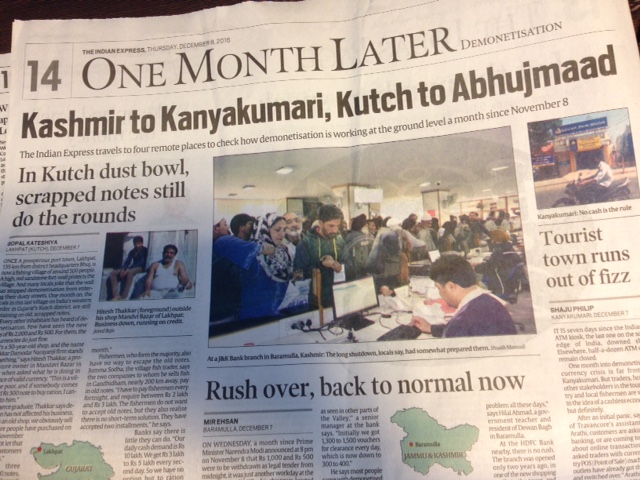
Meanwhile, a month after the great pronouncement, there are places in India, like Lakhpat in Kutch, where the old money is doing just fine, but those who live on the margins, like the scrap merchants and the rag pickers in Mumbai, will not recover for a while.  And even those with jobs in factories are getting their salaries in old notes or not at all, according to this report in Indian Express.  Or in Bastar, where the absence of money makes little difference.

No one in government has explained clearly that even after the deadline of December 30, which the RBI hinted at its meeting yesterday could be shifted forwards or backwards, the old notes can still be exchanged.  Most people assume that after December 30, these notes will be nothing more than pieces of paper.

But, as a reader wrote to me in an email: "I am holding British Pounds which are out of circulation. I do not have to worry about it. Even if I go to England after 10 years, and go to Bank of England, they will exchange it anytime. A promise is a promise. You can check the same on Bank of England website which is still open to accepting notes which were printed in 1725!"

And he asks: "Today, I was holding a Rs 1000 note in my hand in USA and it reads: 'I promise to pay to the bearer the sum of Rs. 1000'. RBI governor has signed it. If a person issues a check to anyone and it bounces back, the person issuing the check can be in jail. In the RBI governor's promise, there is no date mentioned in the note. What value is of that promise?"

The confusion, according to Usha Thorat, a former deputy governor of the RBI, arises "because the GOI (government of India) have not notified the last date beyond which it (old currency) cannot be exchanged at RBI counter - neither in the notification issued under Section 26(2) nor in any of RBI circulars
The date found a mention only in PM's speech of Nov 8.  Hence technically notes continue to be a liability - unless an ordinance is brought in or a legislation withdrawing the promise to pay - which according to me is different from the withdrawal of legal tender - in 1978 there was an ordinance followed by an Act of Parliament. There is a legal view that last date for exchange at RBI can be notified under Sec 26(2) itself without new legislation." For more detail on these issues, read this.

Given the rate at which this government is moving the goalposts, no one will be surprised if some excuse is found to change the last date for depositing old notes in scheduled banks.  As Usha Thorat clarified, the RBI has to continue accepting them unless there is a specific law. 

Meanwhile, while the fisherfolk of Lakhpat in Kutch couldn't care less about old or new money, millions of people wait patiently in line to withdraw their own money.  Most of them have still not understood what exactly has happened.  Many think it will finally lead to something good if the rich and the corrupt are taught a lesson.  Sadly, they fail to see that it is the poor who are paying the price while the rich are laughing all the way to the bank, literally. 


Thursday, December 01, 2016

Creeping Hindutva

One of the regular readers, and commentators, on this blog, complained to me recently that I have not posted anything for several months.  My apologies.  The writing drought has now ended.  Here is something that has not been published, except here.

-->


The last month of 2016 began with this headline in Indian Express: "Individual rights don't matter in this case: Two-judge bench.  All cinema halls SHALL play national anthem before film...doors SHOULD remain shut: Supreme Court".  What is happening?  Where is this country heading?

You don't have to be paranoid or unnecessarily alarmist to conclude that we are hurtling towards a future where National and Hindu are merging and Freedom and Secular are disappearing.

The Supreme Court has ordered the playing of the national anthem in all cinema halls across India in order to instil "committed patriotism and nationalism" and doing so would be part of their "sacred obligation".  Why would patriotism or nationalism need to be "committed" and where does "sacred" come into all this?

The judgment also spoke of "constitutional patriotism and inherent national quality", once again something that only the judges can explain.

To me, this kind of judgment comes as no surprise as one has watched with concern the creeping but determined Hinduisation of Indian society, especially since May 2014 when the Bharatiya Janata Party and Narendra Modi were voted in to power.

Earlier this week, I was at an occasion that should have been, in all respects, a "secular" space as it was celebrating the reading and writing of books.  All kinds of books.  Fiction, non-fiction, children's books, translations from Indian languages, biographies, management, even fitness and health.  The function was held to mark a set of awards judged by a jury and another set of "popular" awards that were decided on the basis of votes from readers.

Alarm bells rang in my head even before the function began as we were informed that one of the important guests present was a functionary of the BJP and a minister in the state government.  Why was someone from the government invited to an occasion about books?

The first few minutes made it clear why.  The evening began with an audio-visual devotional tribute -- representing exclusively Hindu gods.  Lamp lighting, also essentially a Hindu custom, is virtually a norm at many functions in India.  But never before have I seen an outright Hindu devotional opening, almost like going to a temple, at a function that has nothing at all to do with any religion. 

The next item was equally unexpected, and shocking to quite a few of us.  A woman instrumentalist and singer belted out Vande Mataram even as a well-known Kathak dancer pranced around draped in the tri-colours of the Indian flag.  What was this about?  Why Vande Mataram?  If the organisers wanted to establish their "nationalist" credentials, then they could have had "Jana Gana Mana".  The Supreme Court would have approved, given its judgment. But the combination of Vande Mataram and the national flag mean only one thing, celebrating the notion of "nationalism" as propagated by those at the helm of affairs today.

After this dramatic and "patriotic" beginning, it was indeed ironical that the jury choice for the best non-fiction book went to Akshaya Mukul's excellent work, Gita Press and the Making of Hindu India.  In the citation, the jury members did not just commend the research that went into the making of the book but also noted:

"We are made aware of the remarkable energy and tenacity with which Hindu ideologues have pushed the social project of making an India of their imagination. It is also a sobering reminder to many ‘secular’ activists who, probably mistakenly, believe that having a secular constitution is in itself a guarantee of our future as a secular Republic.

In an era of growing majoritarian intolerance, Gita Press and the Making of Hindu India is an important book, a reminder to all of us that making a new society and people is a continuing work in progress."

However, once this award was presented, the rest of the evening veered back towards the direction where it began.  The recipient of one of the popular fiction awards ended his speech with "Jai Sri Ram", the recipient of the popular choice for the best work for children, which was on the Gita, waxed eloquent about the holy book, and a special section at the end was the release of a book of Shivaji.  To lustful cheers from the back of the hall, the first time writer held forth on how wonderful was "Shivaji Maharaj" and how she wanted the whole world to know about him.

The question that comes to my mind is: what is making people bend over backwards to show their commitment to religion and nation?  It is not yet a diktat, although the Supreme Court judgment is precisely that.  Yet clearly there has been enough said, and done, in the last two years to make it evident to people, especially those in business, that it is better to bend over backwards to show your loyalty and patriotism than to be suspected even remotely of being "anti-national".  When writers, who by virtue of their chosen profession ought to disrupt, to instigate debate and disturb the status quo, are instead asked to stand up for one anthem, and sit down and listen to another, we can guess fairly accurately where we are heading.  Or should I say, "Bharat Mata ki Jai!".


Friday, August 05, 2016

Broken News: Bulandshahr rape coverage shows how badly the media needs lessons in sensitivity

A note to readers of this blog:

I've been missing in action for more than a month now. But I'm back and I hope to keep posting regularly henceforth.

In Scroll.in    August 5, 2016

More than three-and-a-half years since the ghastly gang rape in Delhi, the media has learned nothing about how to cover sexual assault.

They sit on charpais, perch of treetops, speak to anyone they can get hold of and in between eat chips and drink cups of chai. This is not a picnic. These are members of the Indian media waiting breathlessly to pounce on anyone who can give them a sound byte for the latest breaking story, the terrifying gang rape of a woman and her 14-year-old daughter on Highway 91 in Bulandshahr, Uttar Pradesh on July 29.

The father of the young girl is instructed to cover his face because the TV-wallahs have not time to blur his face. He pleads, as reported by Hindustan Times on August 3: “How many times should I repeat what happened with my daughter and my wife? They have been raped. What else do you want to know? My daughter was better till last night. With all the people visiting, she is now being asked to recall everything again. She has fallen sick again. She cannot stop crying. Please leave us alone.”

Yet, they persist, the media and politicians. While this is what politicians do, rush to places where they can milk a tragedy for political gain, is this what the media ought to be doing? Has the Indian media lost all sense of perspective? Do words like “sensitivity” even pass through the minds of the editors who assign reporters to such stories? Are there higher standards of insensitivity in the way we handle stories where poor people are involved?

Clearly, more than three-and-a-half years since the ghastly gang rape in Delhi on December 16, 2012, the media has learned nothing about how to cover sexual assault.

Intrusive reporting

Back then, many in the media believed that their focus on the Delhi rape played an important role in bringing about changes in the law even though it was the Justice Verma Committee report that actually pushed the government to make these changes. The media went to great lengths to hide the identity of the woman raped, a requirement under the law, by even giving her a fictitious name. But even then, there were news channels that found out where the woman lived, sent out cameras that exposed the family and would have ultimately revealed the woman’s identity had she survived the horrendous assault.

A little over seven months later, there was another gang rape, this time in Mumbai. In what came to be known as the “Shakti Mills gang rape”, a woman on a work assignment was raped in central Mumbai, a stone’s throw away from a busy railway station. As in the Delhi case, the media went after the story. But had there been any introspection about media coverage since December 16?

There were some superficial changes. For example, some newspapers decided to use the term “survivor” instead of “victim”. Yet, nothing substantial had changed.
Even if no one mentioned the name of the woman, and thankfully did not give her a fictitious name, they thought nothing of pursuing every other angle to the story.
For instance, even when the name is not revealed, by identifying the parents, or husband and children, or the neighbourhood where she lives, or the place where she works, the media is revealing the identity of the woman.

In the Shakti Mills case, Mumbai’s leading newspaper saw nothing wrong in sending a reporter to the building where she lived, and virtually informing the watchmen and the neighbours about what had happened by asking them if they knew that a woman in their building had been gang-raped (read here). It went further by sending a reporter to the hospital to dig out other details about the rape despite the family begging the media not to write about it, and also helpfully gave away the religion of the survivor by speaking to the head of her religious community.

Breaking news

In an age of television, this problem has become worse. In the rush to be the first to get “breaking news”, TV channels have been tripping over their own wires to interview anyone and everyone who can speak of a rape.

What is happening in Khoda, Noida, where the two survivors of the Bulandshahr rape live, is perhaps the most shameful. By hounding them, the media is compounding the horror that these women have to live with for the rest of their lives. They thought they would be safe if they moved back to their own neighbourhood. Now everyone there knows, the young girl cannot go back to school and the family does not know where to go.
Surely this ought to shake us in the media and make us introspect. How many times must we be reminded that our job as journalists is to report but not to exploit the suffering of those who cannot fight back, who are already beaten down, who have no voice in the normal course of affairs?

Predictably though, the media usually refuses to look inwards even as we expose the faults of the world around us. As if to illustrate this, even as Hindustan Times reported on the excesses of the media in the Bulandshahr rape case on August 3, its editorial on August 4 found no mention of this. It castigated politicians and wrote: “The aim should be to help victims get past their ordeal and get on with their lives. For this we need better law enforcement, speedier justice delivery and emotional assistance.” And a more sensitive media?


(To read the original, click here )


Tuesday, June 28, 2016

In Naga villages, sustainable farming is being undermined by need to earn cash for medicine, schools

Scroll.in  June 23, 2016


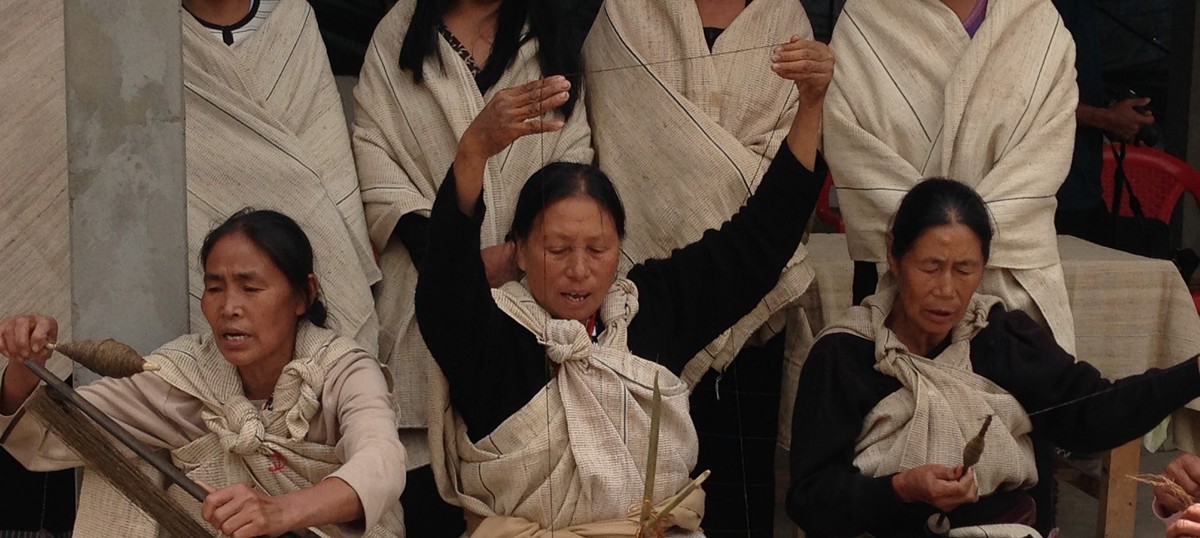
(Women in Leshemi village spinning yarn from nettle: Kalpana Sharma)


When you look down from the main road, the imposing Baptist church in Leshemi village, in Nagaland's Phek district, looks like a wedding cake.

But Leshemi's claim to fame is more than an impressive church. Leshemi is located on the hill opposite Khezakeno village, a place that the Nagas believe is the original village settled by them. From it, they believe, Nagas went off in different directions. The three main Naga tribes, Angami, Chakhesang and Sema, trace their origins to this settlement.

Leshemi is a small Chakhesang village, perched on a hillside with thick forests above and terraced rice fields below. What makes it unusual is that it is virtually a "village republic", a concept Mahatma Gandhi articulated. Its 800 or so inhabitants want little from the outside world, as the women tell you.

"Do you lack anything in your village?" I asked 65-year old Solhouii, part of a group of women who had just demonstrated how they spin yarn from stalks of stinging nettles found in the forest.

She thought for a while, then laughed and said: "No."

Though they do need a few things from outside, Solhouii said that they grow their own rice, millet, vegetables and fruit. They even make salt from brine found in a natural spring. There is plenty of water. They spin their own yarn from nettles and homegrown cotton. And they weave this into shawls and wraps, following the traditional patterns of their tribe.

Unhealed wounds

Like neighbouring Khezakeno, people in Leshemi also believe that they live in one of the oldest villages in Nagaland. As proof they show you what they call their fetish stones (which, they believe, contain spirits and special powers), which were found by their elders. These stones are now being carbon dated to establish their real age.

A stone shrine of sorts has been built around one of the original fetish stones.
Two elderly men, who are hovering around the little structure, tell me that the stone "died" when the Indian army burnt Leshemi village in 1957.

That statement, said sotto voce, is a wrenching reminder of what ordinary people in Nagaland went through from late 1950s till the ceasefire in 1964, during what they call the Indo-Naga war. This was fought between the Nagas, who believed they were independent and not part of the Indian Union, and the Indian government and its army that saw them as insurgents to be forcibly brought into the Indian fold.

I asked these two men if they remember that time. Yes, they do, they told me. For an entire year, the villagers had to hide in the forests. Those who went to the higher reaches survived despite hunger. Those who went to the valley died of disease or could not tolerate the heat and humidity.

The village that stands today was rebuilt after that.

The women and men in Leshemi do not bring politics into the conversation. But you cannot escape the past, the sadness that hangs over such villages, and the memories that live on.
A monolith at the entrance of a village in Nagaland. [Credit: Kalpana Sharma]
A monolith at the entrance of Khonoma village in Nagaland. [Credit: Kalpana Sharma]
The old and the new

Just as the smiles, the jokes and the laughter hide deeper wounds, so does the talk of self-sufficiency.

For the reality in Leshemi, as in other villages in Nagaland, is that changes in the name of modernisation and development are undercutting the self-sufficient nature of their traditional societies.

A group of women farmers (and the majority of farmers are women) explained why today, what they grow is not enough to meet their needs.

A group of Chakhesang women in Chizami village, east of Leshemi village, spoke of the dilemma they face. We need cash, said one, to pay for school fees and medical expenses.
What they grow is enough to feed the family and sometimes there is a surplus that can be sold in the market. But the earnings from this cannot cover these other expenses necessitated by the introduction of education (Nagaland's literacy rate is now 80%) and modern medicine (in the past people relied on local cures).

As a result, the women look for work in the fields of others, where they get paid Rs 300 per day. The men find work as construction workers in the road repair projects that are perennially underway (despite which the roads are in a terrible state), and under the Mahatma Gandhi National Rural Employment Guarantee Act. Boards in all these villages announce improved village roads, or structures like community centres, that have been built courtesy MGNREGA.

Money power

This need for money is one factor that could, in the long run, undercut the sustainable forms of agriculture that continue to survive in many parts of Nagaland and elsewhere in the North East.

For instance, in villages like Leshemi and Chizami, no chemicals are used in the paddy fields. Villagers save seeds for the next planting. And their diet consists of locally grown rice and millet, vegetables, greens and meat, including birds and animals they hunt in their forests. But the need for money leaves them vulnerable to the incentives offered by the government's agriculture department to switch to faster growing hybrids. This also means using fertiliser and chemicals that they have never used before.

The traditional Naga form of agriculture has been organic before that term became fashionable. Their food, too, has the ideal balance that highly paid dieticians recommend to unhealthy city dwellers. But all this could change.

Besides the temptation of earning more, the future of traditional forms of agriculture also depends on the next generation. Will younger, educated Nagas go and till the land like their parents? Or will they only keep the link with their villages during festivals and occasions? This is already happening and is something that worries the women.

These women also know that not everyone wants to do the backbreaking work that is so much a part of their lives. They literally work from morning till dusk.

I asked a woman farmer from Chizami village to describe her typical day: "We wake up at 4 am, light the fire, make tea, cook, prepare children for school, eat something and then go to the field by 8 am. We take a break at 12 and then continue working till 5. On the way home, we collect fodder, then cook, then feed the livestock. We rarely get to sleep before 9 pm."

How many young women and men today will want to follow such a schedule?

Resources threatened

However, the biggest threat to the sustainable existence of such villages in Nagaland and elsewhere in the North East is the policy the Indian government has framed for this region. Essentially, it envisages ways in which the area's forests, rivers, land and minerals can be fully exploited.

Activists say local people do not fully understand the environmental and social consequences of some of the proposed projects. For instance, In Nagaland, new roads and highways are being built cutting through pristine forests. People have consented without realising that easier access to these forests could also spell the end of precious biodiversity. However, in Arunachal Pradesh local communities are asking questions and opposing the many hydroelectric projects being constructed in the state.

"It is scary,” said Akole Tsuhah, a young activist working with the North East Network, a women's rights organisation. “Our people are not prepared for this. Because of the need for cash, it is difficult to convince people about the need to safeguard our resources. Once we lose our common resources, we will lose our independence, our sovereignty."


(To read the rest of the article, click HERE

Also here's the link to another article on Nagaland, women and politics that was published in Scroll.in on June1, 2016 under the headline:

In politics and property ownership, there’s no space for Nagaland's women

https://scroll.in/article/808787/in-politics-and-property-ownership-theres-no-space-for-nagalands-women


Thursday, June 09, 2016

Yes, it's time for a re-think – by people trying to deflect charges of sex crimes by their friends

Scroll.in  June 9, 2016

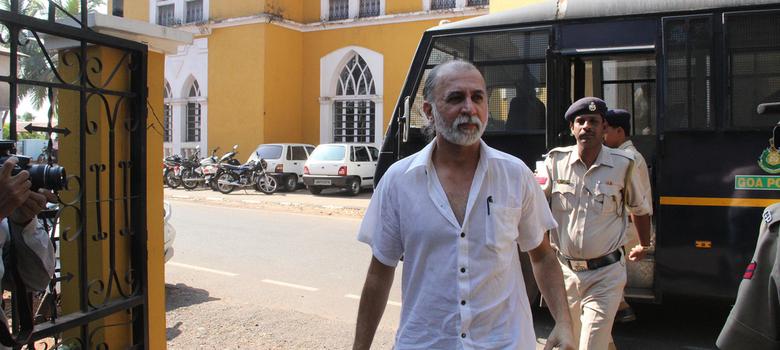
An item in a Mumbai tabloid on Thursday said that journalist Tarun Tejpal, who is facing rape charges, had merely committed a 'grave error'.

Normally, the dozens of ill-informed and vacuous comments that find space in the “diary” sections of some newspapers are best ignored. Yet sometimes a response is needed.

I am referring to an absurd diary item in the Mumbai tabloid Mid-Day on June 9. As I said, it could be ignored as the newspaper is published only in one city, Mumbai, and has a limited circulation. Yet, in these days of Internet and social media, the reach of such publications is amplified.

So Malavika Sanghvi, in her column “Malavika’s Mumbai: The Daily Dish” (last item) that appears on page 8 of Mid-Day has taken up the case of Tarun Tejpal, former editor of Tehelka, who was charged with rape by a colleague, is currently facing trial in a court in Goa and is out on bail.

Under the headline, “Time for a RE-THINK?” Sanghvi refers to the serious rape charge against Tejpal as “a grave error”. And because this so-called error apparently gave “his detractors ammunition to demolish him” through an “excessive” and “relentless media campaign”, she suggests that it is time for “strong liberal voices” to speak out.

(To read the rest, click here.)

Thursday, June 02, 2016

In politics and property ownership, there’s no space for Nagaland's women

In Scroll.in

Link: https://scroll.in/article/808787/in-politics-and-property-ownership-theres-no-space-for-nagalands-women

June 1, 2016

Photograph of women from Sumi village in Phek district spinning homegrown cotton.


While the recent Assembly elections have been the subject of endless chatter in the media, in Nagaland, the question that hangs in the air is: when will we see women governing the state?

Nagaland attained statehood in 1963, but since then, it has not elected a single woman to its Assembly. It has also only ever sent one woman to Parliament – Rano M Shazia, who was elected to the Lok Sabha back in 1977.

This reality pervades through all levels of governance in the state.

Traditional village councils, formalised through the passage of the Nagaland Village Councils Act 1978, have hardly any female representation. And though laws have been enacted providing for 33% reservation of women in municipal and town councils, their implementation has been halted, as a result of which there is not a single woman in these bodies.

Twin battles

What does this say about the status of Naga women?

At first glance, Naga women do not appear oppressed. You meet strong, articulate women, well-known writers, poets, academics and activists. 

You also see women doing backbreaking work in the fields, carrying heavy loads of firewood, cooking, cleaning, weaving or selling vegetables and fruits in markets and by the roadside. 

Yet, a Naga woman cannot call the field in which she works her own, or lay claim to house she manages or even her kitchen garden. If it is ancestral property, she is not entitled to inherit it. 

The only exception is acquired property – parents can gift their daughters land. But after her death, that land will not go to her heirs; it will be returned to her clan. 

For the women in Nagaland, then, the battle is two-pronged – for representation in institutions of governance and for the right to inheritance.

In many ways, the fight for representation in self-governing bodies is symptomatic of the larger battle of Naga women against their society's inherently patriarchal traditional structures. 

A drop in the ocean

Anungla Aier, principal of the Kohima Science College, said that within the traditional definitions of who is entitled to be on the village council, "there is no space for women, in the social or political realm.”

"When you have a state Assembly of 60 men, how can we expect any of them to take steps to bring women into the picture?” she said.

The village councils predominantly consist of men who are selected by villagers. They have powers to govern many aspects of village development, including the use of development funds. In that regard, they’re quite similar to panchayats. The big difference, though, is that they are not elected bodies (in the way that panchayats are) and they have hardly any women.

Additionally, all villages have Village Development Boards (VDB) and a state law in 1980 stipulated that a quarter of their members should be women. Though this provision has been implemented, the resistance to women entering village councils continues.

In the last few of years, a few village councils, mostly in Dimapur and in Phek district in eastern Nagaland have taken a few women on board. Tokheli Kikon, Chairperson of the Naharbari Village Council, is the first and only woman so far to head a village council. 

But these are the exceptions, not yet the norm. 

For those have found a place in the village councils, there is the expectation that they can make a difference, even if there are only two women in a council of 30 or more men. 

One such woman is 38-year-old Konie-u from Enhulumi village in Phek district. A village with around 250 houses, Enhulumi is perched precariously over the state highway running from Kohima to the eastern part of Nagaland via Chizami. If you go there early in the morning, you will only find men. The women have already left for the fields.

Every morning, Konie-u weaves for some time, then leaves for the fields. That morning, she waited, as did her mother, Khwetsozu-u, who offered us sticky rice and then left for her paddy fields.

Konie-u, from the Chakasang tribe, said that three years back, the women's society in the village pushed for women to be in the village council. They finally succeeded last year. They nominated Konie-u, who has studied up to Class 9, along with another woman.

"In the beginning, when we got into the council, we explained to the men that we are not just here to make and serve tea but that we want to participate in the meetings", said Konie-u. 

They told the men that if they want tea, they should tell them early so that it can be made. Even if they wanted lunch, the women would arrange it. But during the meetings, they wanted to be there. 

"Already, within a year, men in the council are starting to acknowledge and listen to us and are telling us that our opinion matters," she said.

Can women really make a difference, I ask?

In Konie-u's opinion, they can. She said that if men eat up 75% of the funds, and leave only 25% for the community, women will ensure that at least 75% of the funds are available for the village. 

Would she be prepared to stand for the Assembly? Konie-u dismissed the suggestion saying that she is not qualified, and doesn't have the money. But, she said, “I believe that we will have a woman legislator from our constituency. I will campaign and push for her.”

Opposition to laws

This is but a small breach in a male fortress. The larger struggle for representation in municipal councils, which revolves around implementing a law and not on the munificence of some men, is proving far tougher.

The Nagaland Assembly passed the Nagaland Municipal (First Amendment) Act in 2006. This provided for 33% reservation of seats for women. But till today, this cannot be implemented because men have argued that this runs counter to customary law. And according to Article 371A of the Constitution, Nagaland is exempt from any law that does not conform to customary laws.

For the last six years, elections to the municipal bodies have not been held, as a result of the ongoing stand-off on the reservation.

A writ petition challenging the state government's refusal to hold municipal elections was filed before the Kohima Bench of the Gauhati High Court on June 26, 2011. 

The petitioners, Rosemary Dzuvichu, an academic, and Abeiu Meru of the Naga Mothers' Association argued that as the law guaranteeing representation to women was applicable to Nagaland and did not violate traditional practices, it ought to be implemented. The government, however, put forward various arguments and also claimed that implementing such a law would upset the peace in Nagaland. 

In October 2011, the court, presided by a single judge, upheld the petition and directed the government to hold the elections to municipal councils and town councils on or before January 20, 2012. 

But before that could happen, the state government filed an appeal before a division bench of the Gauhati High Court. The previous ruling was stayed. 

The petitioners then moved a Special Leave Petition in the Supreme Court in September 2012 and finally got a ruling on April 20 this year. The Supreme Court upheld the single-judge ruling of the Gauhati High Court of October 2011. As a result, the state government and the state election commission must begin the process of holding elections to the urban local bodies. But to date, nothing has happened. 

In the absence of municipal elections over the last few years, funds cannot be released for essential urban services, the consequences of which are evident in the sorry state of Nagaland's towns.

Dzuvichu, one of the petitioners, argues: "When reservation exists in the village development boards for more than three decades, all these excuses about customary traditions, or even by educated women on being equal with men and therefore not needing reservation, are based on ignorance of and denial of the plight of the larger group of women who are voiceless, both the rural and urban poor and marginalised." 

She said that as petitioners, they have written to the Election Commission of India, to the state election commissioner, the chief minister and the Parliamentary secretary of municipal affairs asking them to hold elections.

“The entry of 82 women councillors in 19 municipal and town councils is an exciting event to watch for someone like me who believes Naga women will be good dynamic partners of our men in this strong patriarchal society,” said Dzuvichu. “It will be a turning point for the future of Naga women.” 

The other battleground

With regard to their fight to property rights too, some headway has been made, but there’s a long way to go.

Temsula Ao, writer, professor, and head of the Nagaland State Women's Commission said that a process of discussion to introduce a new law on inheritance has begun. 

"We are trying to see if we can figure out an Act for Naga inheritance," said Ao. "At the moment we are not talking about ancestral property. We have decided we will not touch this hornet's nest. We are just talking about acquired property of husband and wife."

The state women's commission has conducted a series of consultations with the apex bodies of each of the tribes of Nagaland. Men from village councils and student bodies as well as gazetted officers were invited to these consultations. Ao believes that this is the best way to take the issue forward.

Women leaders met after these meetings and formulated the main points they wanted to put to their people. These were then taken back to the tribal leaders and their consent was sought in writing. By the middle of May, Ao said that almost 99% of them had accepted the suggestions made.

After further consultations and endorsements, these suggestions will now be sent to the law department. Sikkim and Mizoram already have laws that address women’s right to inherit property. These, Ao suggests, could help in the formulation of the Naga law.

These debates on women's rights do not make it to the so-called national press as conflict and politics dominate the discourse. Yet, for the future of Naga society, caught on the cusp between tradition and modernity, the outcome of these struggles will be crucial.