Showing posts with label Sharda Ugra. Show all posts

Wednesday, June 07, 2023

Manipur simmers, champions protest, but Modi's focus is on his new Parliament

 Broken News

Published in Newslaundry on June 2, 2023

Link: https://www.newslaundry.com/2023/06/02/manipur-simmers-champions-protest-but-modis-focus-is-on-his-new-parliament

We have witnessed a fortnight of high drama. The contrasting images – of the prime minister of a secular country walking into a new Parliament building accompanied by saffron-clad Hindu priests even as award-winning women wrestlers literally wrestled with the police to assert their right to protest – were riveting. 

One image told us that the concept of a secular state is now history. And the other, that in the new version of ‘democracy’, there is no room for protest or dissent. They also depicted where India is as a country today as captured by the Mumbai-based newspaper Mid-Day. 

The images also spoke to another reality: that one of India’s most voluble prime ministers cannot find a word to say to women demanding action against one of his powerful satraps on charges of sexual harassment.  

This even after widespread coverage of the protest in the international media, and the statement made by the International Olympic Committee which says: “The treatment of the Indian wrestling athletes over the weekend was very disturbing. The IOC insists that the allegations by the wrestlers are followed up on by an unbiased, criminal investigation in line with local law.” 

Ever since the wrestlers began their sit-in at Jantar Mantar, their protest has received widespread coverage, and strong comment in editorials and op-eds. In my view, one of the best commentaries is by leading sports journalist Sharda Ugra. It is a must read because it gives us a better sense of these women who have excelled in a non-traditional sport like wrestling. It also goes beyond the bare details of the protest to help us understand where these women are coming from, what they have endured, and why they know bad touch from good touch. 

Ugra writes that as “elite” athletes, “they have a far better knowledge of human anatomy and physiology than anyone pushing them around. They know how to exert pressure and use weight, maintain balance, use force, inflict and absorb pain. During their protest, the wrestlers have absorbed pain in many forms but chose not to inflict any.”

And she concludes with these powerful words: “India’s protesting women wrestlers have lived and worked with complex contradictions: their sport requires physical hyper-awareness, response and aggression from bodies policed through unyielding boundaries of honour and shame from a young age. At the very least, it should be through sport that these boundaries are crushed into the ground. Not by the police or by political policing.”

If after this you read the details in the FIRs that the Delhi police has finally filed on the basis of the complaints of sexual harassment by six adult women wrestlers and the father of a minor against Brij Bhushan Sharan Singh, you will understand better what they are saying. 

At the time of writing this column, there is a momentary pause in the protest as a five-day ultimatum has been served to the government by leaders of khap panchayats to move against Singh. Failing this, the protesting wrestlers will once again go to Haridwar, as they did on May 29, and immerse their hard-won medals and trophies in the Ganga river.

While these dramatic events were unfolding in Delhi, the seat of political power and the home of the national media, lurking in the shadows were the images of a state literally burning. The state of Manipur in northeast India has been caught in a cauldron on ethnic strife from May 3. Some of it has been reported. For the details you need to search independent platforms, especially those based in the region. 

Yet, it took India’s home minister Amit Shah 24 days before he finally made a statement, and that too from Guwahati, a short flight from Imphal, the capital of Manipur. What he said would have caused more grief than consolation to the troubled people of Manipur. He insisted that the trouble was due to the March 27 ruling of the Manipur High Court granting Scheduled Tribe status to the Meitei, who are the majority in the state. The ruling has since been challenged. 

The home minister should have known better. Nothing is so simple in the northeast or, for that matter, anywhere else in India. But especially in the northeast, a region where each state has a complex history, multiple cultures, tribes, dialects, and faiths. The heavy hand of Delhi has been a constant presence, in the form of the security forces backed by the Armed Forces Special Powers Act. For decades, residents of these states have manoeuvred around this constant, and often ugly, reality. To dismiss the ongoing violence as the outcome of one court ruling indicates a serious deficit in Delhi’s understanding of the region. It reinforces the feeling of many ordinary people in the region that the “mainland” and Delhi do not care. 

As any journalist from the “mainland” who has reported from a northeastern state would know, there are few simple answers to be found to the problems or the conflicts in the region. The best that we can do is to listen to all sides, especially ordinary people instead of just the “authorities”, and report as honestly as we can without judgement. We can also use the chance to understand, at least a little bit, about the history and the distinctive culture of the region.

There have been several reports and articles that have attempted this kind of sensitivity. More often than not, these reports are written by someone from the region, and there are many excellent local journalists in every northeastern state. At times like this, the mainstream media ought to turn to this excellent, well-trained resource instead of parachuting journalists who may not have an adequate understanding of the region.

Take, for instance, this piece in Article-14 by Kimi Colney, a journalist based in Mizoram. It gives us a flavour of what ordinary people have suffered on both sides while at the same time placing in perspective the history of the tensions between the majority Meitei, who make up 53 percent of the population of 3.3 million, and the minority tribal groups that include the Kuki. It is worth taking the time to read this long article to get a fuller picture of the current conflagration in the state.

Interestingly, Colney also reports that people in Manipur are wondering why the prime minister is silent. She quotes Babloo Loitangbam, director of advocacy group Human Rights Alert: “What is most surprising is that till date the double engine government of Modiji (a reference to BJP governments in Imphal and New Delhi) has not made a statement on what is happening today...The honourable PM does not have five minutes to spare and make a statement, this is very strange.” 

In all conflicts, there is a trigger, but behind it is a long history that needs to be understood and acknowledged. Anyone with even a perfunctory understanding of the region would know that you cannot simply blame a high court ruling for the current violence in Manipur.   

Unfortunately, those in power at the centre, or even in the state, appear not to care about this, thereby aggravating the hurt and the frustration of the ordinary people of Manipur, both Meitei and Kuki, who are caught in the violence. An imposed peace from Delhi will not erase the history of mistrust that lies at the root of the current violence.

Update at 11.30 am, June 3: The FIRs contain allegations against Singh by seven wrestlers, including a minor, not 10 wrestlers. This has been corrected.


Saturday, March 18, 2023

Despite new focus, media misses the darker story about women in sports

 Broken News

Published in Newslaundry on March 9, 2023

Link: https://www.newslaundry.com/2023/03/09/despite-new-focus-media-misses-the-darker-story-about-women-in-sports


While mainstream media continues to focus on games politicians play, this column will focus on the games women play, as in cricket, tennis, football, hockey, athletics, etc., and how the media covers their struggles and achievements.

International Women’s Day (IWD) has just gone by and women in India are being praised, their successes celebrated even as they continue to be targeted for consumer goods, or continue to suffer ‘mansplaining’ as erudite ‘experts’, usually all men, hold forth on what should be done to promote women’s WDequality. All of this has become an annual and rather predictable ritual.

But even this ritualistic acknowledgement of one day for women was not the norm earlier. In fact, I can recall in the mid-eighties, when I worked for a national daily newspaper, trying to persuade my editor to carry an editorial to mark the day. This was a time when Indian women’s groups were on the streets demanding changes in laws that affected women such as rape and dowry. To his credit, the editor did agree that the day was worthy of an editorial comment. 

Now, although IWD is readily acknowledged, for the rest of the year, it would appear that no day is women’s day as the majority of Indian women continue to fight against misogyny, sexual harassment at the workplace, violence in their homes and on the street, unequal pay, low employment, poverty and much more.  

Yet, some things are changing, slowly. One cannot help but notice the sudden spurt in coverage of women in sports in the print media. Has the media suddenly woken up to the fact that these women also deserve attention? More likely, however, the attention is a consequence of big money finally backing some women’s sports, such as cricket.

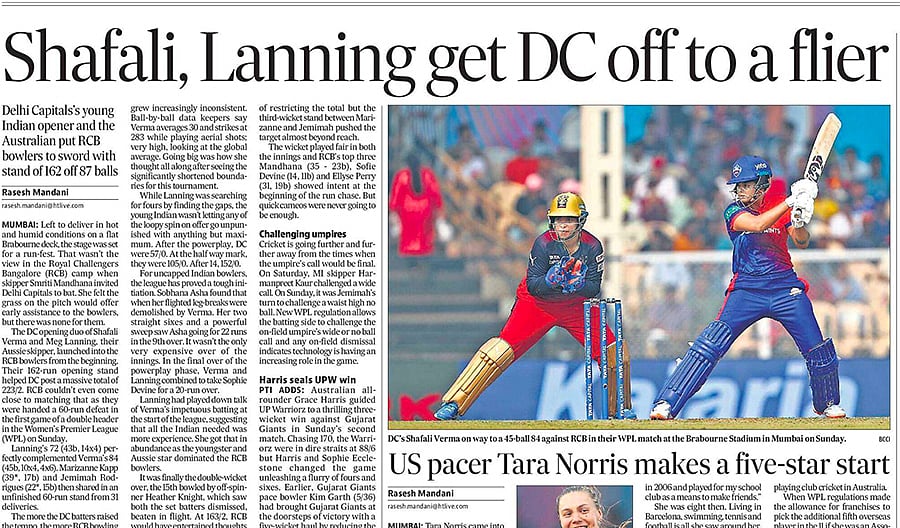
There’s little doubt that the Women’s Premier League has catapulted women’s cricket to the top of the sports pages. Women have been playing cricket for a while, and doing well. But rarely did they get the kind of media attention they are getting today. 

Before the WPL, the U-19 Women’s cricket team won the World Cup. The Indian Express wrote about their victory in their lead story on the sports page with an unfortunate headline.

“First Ladies”. Ladies? Really? These are determined and plucky women who have fought to play a sport they love and excelled in it. “Ladies” is hardly the appropriate way to describe them. 

Fortunately, the rest of the page told a different story as reports about individual players revealed that most of these women came from so-called “humble beginnings” (a cliché that has been bleached of all meaning). Not only did they struggle to find financial resources to train but they also had to fight the embedded misogyny in Indian society that holds back young girls from pursuing their dreams such as recounted in this story about bowling all-rounder Archana Devi.

Archana’s story exemplifies in many ways the story of women’s sports in India today. Unlike individual sports like tennis or badminton, team sports like hockey, football, and cricket as well as athletics attract women from less-privileged backgrounds. Each story you hear after they succeed speaks of their struggle to first overcome familial opposition, then convince a sports association to give them a chance.

In this important story on women’s sports, Shivani Naik of Indian Express, writes about the results of a recent survey of women in sports. It revealed that sports women had to overcome “poor access to sports facilities, no equipment to play, having to travel more than 10 km to reach the facility, safety concerns, lack of preferred female coaches, unsafe travelling to tournaments and discrimination in sport”. Apart from this was the perennial issue of lack of toilets and even safe drinking water.

In Bihar, women athletes who chose to wear shorts while training as they were more comfortable rather than salwars had to contend with men who “would surround the group and stare, which could get intimidating”. 

These are stories that need to be excavated and reported by the media. They are a necessary reality check on women’s sports in India. While the individual stories of the women who succeed are important, as they play a role in encouraging other women who dream of making a career in sports, the difficult conditions sportswomen face once they have taken the first steps, also need to be highlighted.  

Apart from this, there is also a darker story about women’s sports that emerges occasionally, and then disappears.

This year, the sensational accusations made by leading women wrestlersagainst the head of the Wrestling Federation of India, Brij Bhushan Sharan Singh, once again forced open the hidden world of sexual harassment in sports. There have been numerous other instances reported over the years. Some of them have received passing attention from the media but not enough to compel those in authority to act. This time, the women wrestlers who are speaking out will not be silenced. 

That these young women who come away from their homes for training in various sporting facilities are vulnerable goes without saying. As this editorial in The Tribune points out: “Young female athletes, often coming from an underprivileged background and staying at a sports training centre far away from home, stay silent as sports federation officials and coaches possess complete authority over their career and future. In team events, this can lead to the axing of a sportsperson who spurns the advances of a coach or an official; in individual sports, such a strong-willed player can be penalised citing indiscipline or lack of fitness.” 

Also, as Anupriya, a former cricketer writes in this article in Scroll, “Due to the historical ties of powerful politicians to sporting bodies, and the revenue sports provide to media institutions, there is almost an incentivised culture of hushing up whistleblowing. Indian athletes will always be vulnerable because the very nature and structure of sports rely on conforming to established norms and existing within the ecosystem.”

Sharda Ugra, one of the first women journalists to cover sports, reminds us how even when sexual harassment charges surface, they are addressed or rather not in this article in espncrickinfo. She refers to a 2018 incident when two women cricketers complained about the inappropriate behaviour of a senior Board of Control for Cricket India (BCCI) official. 

Ugra writes: “The whole exercise, undertaken with correct protocol and procedure, was, however, pitted with mishaps and missteps, in deed, language and public perception. It could become a case study for every corporation in the public eye as to how not to behave when attempting to follow the rule book in response to allegations of sexual harassment against their top brass. A case study also on why women in any industry find it hard to lodge any formal protest against powerful men in their business.”

Perhaps it is expecting the impossible to believe that a media, fuelled by the same corporations that back some sports, would be willing to expose the way these sports federations, often run by powerful politicians, deal with issues like sexual harassment. But after the attention drawn to the issue by the women wrestlers, I would suggest that this is a story that needs more media exposure.

Also, this would be an appropriate time for the media to introspect about the way women’s sports have been covered so far. In the past, coverage has swung between outright misogyny, where the only interest in women who played sport was in how they looked or dressed, to one where they got sporadic attention when a team, or an individual, did well. Today, despite a spurt of interest in women’s sports, for the most, sports pages continue to be dominated by men’s sports, including coverage of even minor tournaments. Surely this must change.