Showing posts with label Farmers' protest. Show all posts

Sunday, February 25, 2024

Modi govt’s message for 2024, with blocking orders and an OCI cancellation

Broken News

Published in Newslaundry on February 22, 2024

Link: https://www.newslaundry.com/2024/02/22/modi-govts-message-for-2024-with-blocking-orders-and-an-oci-cancellation


The Narendra Modi government hates the concept of ranking countries on a press freedom index, an exercise that Reporters Without Borders undertakes each year. The last such ranking, in 2023, placed India at 161 out of 180 countries, below others in our region, including Pakistan (150), Nepal (95), Sri Lanka (135) and Bhutan (90). Only Bangladesh has the distinction of being two notches lower at 163.


So, in 2024, will India’s ranking in this index sink further?


Going by the government’s actions since the beginning of this year, there is more than a good chance that it will.


On February 9, Caravan magazine received a notice from the Information and Broadcasting Ministry about an article it had published on February 1 titled, “Screams from the Army post”.  It was given two days to respond. The magazine did respond but the ministry was not satisfied. On February 11, a meeting on Zoom between representatives of the ministry and Caravan was held. Later, on the same day, the magazine received a notice that it must take down this article within 24 hours.


What was the offending article, that has now been taken down, about? It was a detailed story written by Jatinder Kaur Tur on allegations of torture by the Indian armed forces against civilians from Rajouri and Poonch in Jammu and Kashmir in December 2023. Three of the 25 men picked up for questioning died in army custody.


The government used Section 69A of the IT Act, a section that has been challenged in several high courts, to justify its action. The section permits the government to take down any content that it concludes threatens the “sovereignty, integrity, defence of India, security of the State, friendly relations with foreign states, or public order or for preventing incitement to the commission of any cognisable offence relating to the above”.


The government’s concerns about certain types of information coming out extends not just to platforms and publications located within India, but even those outside. Thus, in January, the Hate Tracker, a platform that documents incidents of hate speech and hate crimes in India, but is located outside the country, was blocked in India. This report in Article 14 sets out the details. The reason? The same as that used for the Caravan article under Section 69A.


The government has also demonstrated its inability to accept the right of foreign journalists based in India to report freely what they see and hear. On February 16,Vanessa Dougnac, a French journalist who has lived and worked in India for 25 years, was told she would have to leave the country. Her Overseas Citizen of India (OCI) status was withdrawn. She was told that her work was “inimical to the interest of the sovereignty and integrity of India, the security of India and to the interests of the general public”.


In a statement before she left, Dougnac said: “Today, I am unable to work and have been unfairly accused of prejudicing the interests of the state. It has become clear that I cannot keep living in India and earning my livelihood. I am fighting these accusations before the competent forums, and I have full faith in the legal process. But I can’t afford to wait for its outcome. The proceedings with respect to my OCI status have shattered me, especially now that I see them as part of a wider effort by the Government of India to curb dissent from the OCI community.” 


As one can imagine, a foreign correspondent being asked to leave on dodgy grounds has not gone unnoticed around the world. In a strong and explicit statement, RSF stated:


“Forcing a seasoned professional journalist to leave India after she had been based there for two decades reveals a very dark and deplorable image of what press freedom has become under Prime Minister Narendra Modi. With two months to go to general elections, the vice is tightening on foreign correspondents who try to cover India in a professional manner. We condemn the unacceptable way Vanessa Dougnac has been treated and the use of absurd accusations as a subterfuge to gag and intimidate outspoken reporters. The Indian authorities must guarantee journalists’ safety and freedom to work.”


The latest action of the government is an order sent to X on February 19 asking it to take down several accounts. Coincidentally, most of these are independent journalists using social media to report on the ongoing farmers’ agitation. These accounts provide us with detailed news about the agitation, about the way the farmers have had to face tear gas dropped by drones and rubber bullets fired by the security forces standing behind concrete barricades to prevent them from marching to Delhi. On February 21, the first death of one of these farmers – 24-year-old Shubhkaran Singh – from a bullet injury was reported.


Coincidentally, or perhaps not, one of the accounts taken down is that of independent journalist Mandeep Punia and his platform Gaon Savera. People might have forgotten that Punia was central to the reporting of the previous farmers agitation in 2021. In this article he wrote for Outlook magazine in 2021, he describes his arrest by the police, and the stories he heard and reported during those months.


Although X has complied with the government’s orders, as it has done in the past, this time it has issued the following statement: “In compliance with the orders, we will withhold these posts and accounts in India alone; however, we disagree with these actions and maintain that freedom of expression should extend to these posts.”


You might think one article, one foreign journalist being expelled, and a few social media accounts being taken down does not represent any real threat to freedom of the press in India. But it does.


What these three incidents in the first two months of 2024 illustrate is the intent of this government. Clearly, it is determined to do whatever it takes to suppress critical independent reporting.


It does not care what international groups like RSF think. It does not care where India is ranked in a press freedom index. It is only interested in ensuring that the narrative that it has endorsed about what is happening anywhere in this country, which is dutifully amplified by mainstream TV, is the one that all media should echo. Those who refuse, do so at their own risk.


Monday, November 29, 2021

From Narmada Bachao Andolan to farmer protests: Why the media must record history

Broken News

Published in Newslaundry on November 25, 2021

Link: https://www.newslaundry.com/2021/11/25/from-narmada-bachao-andolan-to-farmer-protests-why-the-media-must-record-history


In his usual dramatic style, prime minister Narendra Modi pulled another rabbit from his topi on November 19.

After a year of ignoring the thousands of farmers protesting at the gates of the national capital, demanding the repeal of the three farm laws rammed through parliament by his government, after dismissing their agitation as nothing more than one that was instigated by "andolan jeevi", people who live for protests, he conceded. The laws are being repealed.

While the debate after the announcement has centered on the motives behind the climb-down, and the lessons all political parties can derive from the determination shown by the farmers, another question that must be asked is what lessons the media can learn from the way we covered this remarkable, and historic, civil movement.

With a media obsessively focused on “breaking news” and dramatic events, something as long lasting, and peaceful, as this protest poses a challenge precisely because it is not one, or even a series of events. It is the result of processes that include the state of agriculture and decades of frustration.

When we look back at this year, what viewers and readers are likely to recall in relation to the farmers' protest is a handful of events, such as the standoff between the Delhi police and some of the farmers on Republic Day this year, and how one group climbed the ramparts of the Red Fort in Delhi and raised a flag. Or images of traffic jams on the day the Samyukta Kisan Morcha called for a nationwide bandh.

The result of this kind of bits-and-pieces reporting is that only the spectacular, the violent, the confrontationist, remains in memory whereas the core of this remarkable movement might be erased from public memory.

What will be forgotten, because it was barely reported, was the amazing diversity represented in those who stayed the course over this year. They were women and men from several states, not just Punjab. Many came to show their solidarity. Yet many stayed on. Their stories are worth recording. A few diligent reporters, mostly outside the mainstream from independent digital platforms like Newslaundry, have done just that.

Also, early on the protesters were clear that they could not depend on mainstream media to tell their story. So, they set up their own digital website, Trolley Times.

There were so many stories to tell: the way this protest was organised, that it remained peaceful, that people were fed and housed, that medical aid was available, as this piece by Priya Ramani illustrates.

And let's not forget the women. They were not just helpers, making rotis and being in the background. They assumed leadership roles that only a few in the mainstream media noted.

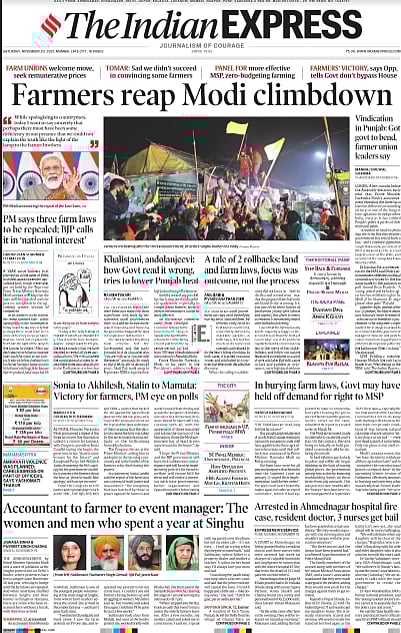
Fortunately, after Modi's announcement, some in the media made an effort to provide adequate background to readers. The most notable was the November 20 edition of the Indian Express that reported not just the announcement but also provided readers with background of all aspects of the struggle.

And, of course, Ravish Kumar in his primetime programme on NDTV India, who gave us the visuals that we should always remember, including the extent to which the Delhi police went to prevent the protesters from entering the city by digging up the road, embedding spikes, and barricading them with huge containers.

It is not always easy to report on something that continues for so many months. How do you find new angles? Besides, how many media organisations are prepared to assign such movements as a legitimate beat for their reporters? I had discussed in a previous column, marking 300 days of the farmers' protest, the challenges journalists face in covering large civil society gatherings.

A similar challenge faced us decades ago when we reported on one of the longest civil society movements of recent times: the struggle against the big dams on the Narmada River and, specifically, the Sardar Sarovar Project in Gujarat.

The movement, the Narmada Bachao Andolan, was launched in 1985. It began with demanding proper rehabilitation for the people who would be affected by the dam. But in the face of refusal by the Gujarat government to even discuss this, it went on to oppose the construction of the dam.

The NBA successfully mobilised the tribal communities that would be most affected. It also asked questions about the environmental costs of the dam that would submerge many hectares of primary forests. The movement was one of the first to question developmental policies from the environmental perspective. Until then, large and grandiose projects were celebrated as great achievements in a developing country.

For the journalists covering this movement, there were many dimensions that needed to be understood. The perspective of the tribal communities who would be most affected by submergence, for instance. These were people who had lived for decades with developmental neglect such as lack of roads, medical care, education, sources of livelihood, etc. What little they could eke out from their lands and the forests was also being taken from them.

The counter story was India's need for electricity and water for irrigation. It was argued that only if projects were built on this scale could this be done and the collateral, in terms of submergence, was unavoidable.

This was a time when print dominated the media. We did not have 24/7 news channels. Hence, reporters and photographers had to tell this story. And like the farmers' protest, although there were a few dramatic events, the main story consisted of understanding and reporting on the reasons for the resistance, the extent of the impacts of the project, and the stands taken on both sides.

The movement, led by Medha Patkar and her team, did not succeed in stopping the Sardar Sarovar Dam from being built. But the protests drew international attention, and led to serious rethinking in the World Bank about funding such projects in the future.

The fact that even mainstream media houses sent out reporters and photographers to cover this protest played no small role in this. Without that kind of documentation, the movement might have been restricted to the specific areas where people had been mobilised, mostly well away from media centres.

When we look back, it is striking how many journalists followed the story over many years and their news organisations gave them the space to do so. It was an education in how the other half in this country survives. Going to those sites of submergence, seeing the conditions in which the tribal communities lived, understanding their continual struggle for basic survival was a lesson in understanding poverty and misguided developmental policies.

The tragedy is that even those villages that escaped submergence in these tribal districts, because they were on higher ground, continue to suffer neglect in terms of basic health care, education or road connectivity. In all these decades, little has been done to change this reality.

In this 2015 article, "Chronicle of a struggle retold" in the Hindu, sociologist Shiv Visvanathan beautifully encapsulates the decades of struggle by the NBA. He writes, "If you were to ask a middle class person today what the most significant act of history in India of the last 20 years is, most would say this – the rise of Narendra Modi. But to me, the most important historical event of the last two decades has been the battle over the Narmada dam."

The article is a calendar of events starting in 1961 when Jawaharlal Nehru laid the foundation stone of the Sardar Sarovar Project to December 2000, when 350 people trying to present a memorandum to the Chief Justice of India in Delhi about the project were arrested. The most memorable was the Narmada Sangharsh Yatra in December 1990, which was stopped by the Gujarat police at Ferkuva on the border of Madhya Pradesh and Gujarat. For those, including journalists, who want to get a glimpse of this long and peaceful civil society movement, Visvanathan's article is a vivid summary.

The lands and the forests of the tribals who lived on the banks of the Narmada are gone. The benefits of the irrigation and electricity generated by the project have not accrued to them. But their story has been documented – in films, in books, in newspaper articles.

The farmers who are protesting are not leaving yet. But their story, and that of their movement, awaits similar documentation. Doing this is not being partisan. It is what we ought to be doing. Recording history as it takes place, so that future generations will know why and how thousands of women and men, who grow the food we eat, chose to sit it out on New Delhi's borders in the heat, in the rain, in the cold for a year.


Monday, October 18, 2021

As we celebrate the Maria Ressas of the world, let's not forget the Raman Kashyaps

 Broken News

Published in Newslaundry on October 14, 2021

Link: https://www.newslaundry.com/2021/10/14/as-we-celebrate-the-maria-ressas-of-the-world-lets-not-forget-the-raman-kashyaps


On October 3, Raman Kashyap, a journalist not known outside the place where he worked, was killed. He was covering a farmers' protest in Lakhimpur Kheri. He was one of the eight people killed when a car rammed into the protesters and in the violence that followed.

A week later, on October 8, the Nobel Prize Committee announced the recipients of this year's Peace Prize: two well-known journalists from the Philippines and Russia. Both have been recognised for their courageous journalism in their respective countries. Both have fallen foul of their governments. Both are determined to continue doing what they have been doing for years. As the chair of the Norwegian Nobel Committee said when announcing the award, they were chosen not just for their courage but also as “representatives of all journalists who stand up for this ideal in a world in which democracy and freedom of the press face increasingly adverse conditions.”

Maria Ressa and Dimitry Muratov's selection for the Nobel Peace Prize has sent out a strong message of encouragement to other journalists like them around the world, but also to governments who continue to deny press freedom that their actions are being noted.

There is much we can learn from the work of both these journalists. Apart from their courage and their persistence in doing what they see as their primary duty as journalists, to be unafraid to investigate and report the wrongdoings of the powerful, their life and work also illustrate the importance of building institutions with people who can make this kind of work possible.

Maria Ressa is one of the founders of the website Rappler that has taken on the Philippines government led by president Eduardo Duterte. Dimitry Muratov established Noyava Gazeta in 1993 and continues to write fearlessly despite living under the regime of Vladimir Putin that permits little by way of press freedom.

But even as we celebrate the Nobel Peace Prize for Ressa and Muratov, let's pause for a moment and think about 35-year-old Raman Kashyap. He was a freelance journalist who sent reports to a local TV channel, Sadhna TV. According to Wikipedia, Sadhna TV is "an Indian spiritual television network owned and operated by Sadhna Group. It was launched on 18 April 2003."

Kashyap had joined the channel just two months ago according to his family. His other job was as a schoolteacher. He was married with two children aged 11 and three. He earned around Rs 500 for every story he filed, if it was used.

There are thousands of Raman Kashyaps who are a part of the media scene in India. But they are hardly ever recognised or even acknowledged. Kashyap has gained more fame in his death than he ever would have had he lived and continued to work as a district journalist.

In fact, his death throws a light on this army of underpaid and even unpaid news-gatherers that are so vital to the news business.

Sevanti Ninan, in her seminal book Headlines from the Heartland (Sage, 2007) recorded the growth of this hidden army of news-gatherers. They are not even designated as journalists. Most of them are not trained. And many do other jobs and fill in as journalists, or stringers, when required.

This process of localisation of news, which began in the mid-1980s, really took off in the 1990s. By then private television channels had entered the media scene. They swept up a large chunk of advertising that would have gone to print media.

This is when regional newspapers, starting with Eenadu in Andhra Pradesh followed by big Hindi newspapers like Dainik Jagran, Dainik Bhaskar and Hindustan, began the process of localisation. Beginning with introducing pages that accommodated district news, they even went on to have district editions. The aim was to sweep up local advertising as well as readership. This was a strategy to leverage their reach into semi-urban and rural areas with the big consumer products companies that wanted to reach these markets.

The formula worked as was evident in the growing circulation of these papers. But alongside, this also spawned a new breed of journalist. These men were tasked not just to report, but also to bring in advertising. Payment was by way of commission based on the amount of advertising they brought in. The reporting was mostly unpaid. But the person got a visiting card that identified him as a representative of a media group. That was currency in these rural settings; it gave the person status and some legitimacy.

According to Ninan, "Without exception every localisation drive in India's Hindi heartland was riding on the willing backs of a host of largely unpaid stringers, filing quantities of miscellaneous news from their immediate neighbourhood." (page 116) She notes that newspapers like Dainik Jagran or Hindustan would have, at any time, from 200 to 1000 stringers in a state. Ninan's book is replete with many fascinating details about the localisation of news and is worth revisiting as we think of journalists like Kashyap.

Only around 2005 did these newspapers introduce some form of gate keeping, by authenticating the information coming in from their stringers. Given the caste and political hierarchies that operate in a rural setting, how would one know for sure that the information was legitimate? An important step taken was to relieve stringers of the task of collecting advertising, thus removing the very real possibility of conflict of interest.

The process of newsgathering by part-time journalists that began with newspapers continued with television channels, especially the smaller ones. And now, with the advent of the internet and social media, anyone with a smartphone can become a journalist. To have eyes and ears on the ground with minimal additional investment is something that most media houses would welcome. And that is what they do.

But when one such journalist lands in trouble, or is injured, or even killed, there is no one who comes to his or her aid. As Jitendra Singh, another local journalist from Lakhimpur Kheri tells Shivangi Saxena in this short video posted by Newslaundry on Twitter, no one cares. Even the events of Lakhimpur Kheri would have passed without creating such a stir had the video showing the men being mowed down, shot by a local journalist, not surfaced within a couple of days. It was delayed, as Singh points out, because the internet was shut down and those who had footage could not share it until a couple of days later. He says, "Big Media came after the violence. There wouldn't have been any proof of the violence had we not been there."

That visual proof that these local, poorly paid journalists provide has proven repeatedly to be the essential building block of a larger story. The most recent of these is Lakhimpur Kheri but there are many like this from the past. The reach of Big Media, as Jitendra Singh calls it, would be greatly reduced if these men were not feeding the news machine.

From the perspective of the big media houses, there is always the question of credibility and authenticity of the reports that come, by way of district stringers. But there are ways to double check. The inputs from these stringers provide a lead, much as news agencies with reporters in more places than even the largest newspaper chain have always done. This is what media houses need to acknowledge and back grassroots news-gatherers, many of whom take considerable risks while doing their jobs.

Saturday, October 02, 2021

See nothing, say nothing: How India's 'well-behaved' media approaches protests and civil movements

 Broken News

Published in Newslaundry on September 30, 2021

Link: https://www.newslaundry.com/2021/09/30/see-nothing-say-nothing-how-indias-well-behaved-media-approaches-protests-and-civil-movements


Media has the power to kill civil society movements by simply ignoring them. It can distort what they stand for, and sections of the media do this all too frequently, but even this is better than blacking them out together.

A case in point is the farmers' agitation that has now crossed 300 days.

Last year, when farmers from Punjab, Haryana, UP and other states gathered on the borders of New Delhi and protested the passage through Parliament of three laws that affected their lives and livelihood, the Delhi-based so-called "national" media was compelled to take note. Even negative coverage made people in the rest of the country aware that something important was happening.

But since then, barring days when there were clashes with the police, as on Republic Day this year, a good section of mainstream media, particularly television, chose to side step this massive gathering even as world media took note.

And now, on September 27, when the Samyukt Kisan Morcha, a coalition of many different groups participating in the agitation, called for a Bharat Bandh, all we read or heard was news about traffic jams, inconvenience to urban commuters, and about "the public held to ransom".

Why did the farmers call for a bandh? Did people realise that the day marked a year since the government passed the three "black" laws, as the agitating farmers called them? Why was the government not listening to their demands? Public memory is notoriously short. People forget, unless reminded, why such a long-drawn out peaceful protest continues. This is what needed to be reported alongside the immediate developments through the day such as traffic slowdowns etc.

To sustain a protest involving such large numbers is no small achievement. The protesters have been determined, but also imaginative in their outreach, effectively using social media to document and spread their news. All the while knowing that the response of mainstream Indian media would be lukewarm at best and silent at worst.

Writing about the farmers' protest, social anthropologist AR Vasavi, points out in an op-ed in Indian Express, “Barring a few newspapers and television channels, the mainstream media has not only blocked out news and updates of the movement but has resorted to spreading disinformation and calumny against the movement. The media has largely succumbed to the dictates of the state and corporate interests and has failed in its democratic responsibilities. In deploying their own media to disseminate information and to represent themselves, the farmers have not only become media-savvy but have indicated that sharing information and open communication are key to democratic movements."

She is right.

The media on the whole has "succumbed to the dictates of the state and corporate interests and has failed in its democratic responsibilities." It has followed a predictable script to snuffle out a social movement, by ignoring it or demonising it. Thus it has ensured that the government too can continue to do so.

Yet, this same media picks and chooses the agitations it deems worthy of coverage. Think back to 2011 and the India Against Corruption campaign led by Anna Hazare. Or 2012 and the outrage that followed the gangrape of a young woman in a Delhi bus. All media, especially TV, gave the protests that followed blanket coverage. In 2012, media focus played an important part in putting pressure on the United Progressive Alliance government to pay heed to demands of changes in the rape law. A committee was set-up under the chairmanship of the late Justice JS Verma. A report was ready within a month. Some changes were made in the law. And the case itself was fast-tracked. In March 2020, four of the accused, who had been awarded the death penalty, were hanged.

By way of contrast, take what is happening in what came to be known as the "Hathras horror". On September 14, 2020, a 19-year-old Dalit woman was gangraped in fields near her house in Hathras, UP. She survived long enough to give a dying declaration and name the rapists, four upper caste men from her village. On September 29, she died in the hospital where she was being treated for her injuries.

In this case too, there was an initial spurt of media attention, especially following the hurried cremation of the girl by the police against the family's wishes. But since then, there has been virtual silence. There have been no demonstrations demanding justice for her. The state government has hardly said anything; nor has the central government. And even as the case drags on, the family of this girl – who have been provided protection by the state – live in dread of the vengeance the powerful and dominant upper castes in the village could take on them and other Dalits.

An integral part of effective journalism is follow-up. You don't report on something just once. You keep checking to see what is happening and continue reporting. This ensures that important issues do not slip under the radar; that both the public and governments are informed.

In the Hathras case, a handful in the media has remembered that September 29 marks one year since the death of the Dalit girl.

Nidhi Suresh from Newslaundry, who has followed the case closely over this year, paints a picture of the fear in the handful of Dalit families living in the village, and particularly what the friends of the victim experience every day. The report emphasises yet again the importance of follow up because the story is far from over with the arrest of the accused. Without media spotlight, who is to say what will happen in a place of such heightened inequality, where the power of the state can subvert the justice system, not just by constant delays but by fudging evidence, too, as was attempted in this case.

A story on the BBC website describes the threats and intimidation that Seema Kushwaha, the lawyer representing the family, faces in court. On most days, she says, the police have to escort her car to the state border for her own safety and her appeal to move the case out of the district has been rejected.

The Hindustan Times, in its report on Hathras, quotes Manjula Pradeep, director of the Dalit Human Rights Defenders Network: “The initial focus on Hathras ensured that things moved but over the past year, the pace has slowed, the trial is sluggish and things are back to being difficult for the family. There is hardly any improvement in the condition of local Dalit women, and the power structure continues to be dominated by the upper castes.” More reason for the media to keep its eye on such cases. Yet, only a handful of media organisations persist in reporting on cases that are neither high profile or urban based.

How has our media descended to this level where issues that matter to ordinary people are routinely ignored? According to US president Joe Biden, the Indian media is "much better behaved" than the US media. He said this in an off-the-cuff remark during his meeting with Prime Minister Narendra Modi in Washington. But is that a compliment? The media's job is not to “behave well” but to make the powerful uncomfortable.

Aunindyo Chakravarty, in an article in Newslaundry, suggests that the Indian media has turned into a public relations machine for the government and corporations. And part of the reason, he writes, is the economics of running media houses, especially television.

In fact, it is cringe worthy that after the prime minister returned from his short visit to the US, leading newspapers like the Times of India and Hindustan Times felt not the slightest bit embarrassed in carrying agency reports that described in glowing terms how Modi is able to overcome jet lag by tuning his body clock to the country to which he travels!

However, the changes in media business models began in the 1990s. Until 2013, the media on the whole was far from a PR machine. In fact, the mainstream media was quite critical of the previous UPA government.

In the last seven years, since Modi and the BJP came to power, the change is noticeable. A large part of the Indian media has chosen to be cheerleaders for the ruling party, and in particular for the prime minister. The reasons may be partly economic, but many have also made a conscious choice to join the chorus line and “behave” themselves.


Sunday, February 07, 2021

Questioning the state’s version of events is not a crime. It’s the media’s job

 Broken News

Published in Newslaundry.com on Feb 4, 2021

Link: https://www.newslaundry.com/2021/02/04/questioning-the-states-version-of-events-is-not-a-crime-its-the-medias-job


Even as the world of social media, and our ministry of external affairs, jumps through hoops over tweets by two "outsiders", the singer Rihanna and the climate activist Greta Thunberg, on the ongoing farmer protests in India, there are weightier issues that continue to confront this nation.

There is, of course, the continuing protest by farmers, not just a handful as the ministry would like the world to believe, but by thousands stretching across northwest India and supported by farmers' groups in other parts of the country. Talks between their representatives and the government have hit a roadblock, hopefully not as impregnable as the trenches that the Delhi police is busy digging on all roads leading into the national capital.

For the media, there remain several questions that have come into focus due to the farmer protests and the events that took place in Delhi on Republic Day.

The most recent issue being debated concerns FIRs filed by the police in Uttar Pradesh and Madhya Pradesh against several prominent journalists and a member of parliament, invoking sedition, conspiracy, and promotion of enmity between different sections. All this for tweets and statements on TV relating to the death of one of the protesters, Navreet Singh, on January 26.

A video clip was circulated on social media showing Navreet Singh's tractor overturning after it hit a police barricade; his family and some eyewitnesses claim he was shot first and thereafter lost control, as this follow-up story in the Caravan reports. The people against whom these FIRs have been filed include Congress MP Shashi Tharoor, India Today anchor Rajdeep Sardesai, author and senior journalist Mrinal Pande, and Caravan editor Vinod Jose.

Their crime: tweeting the version about Navreet Singh being shot, or carrying stories that questioned the police version that it was an accident, as in the case of Siddharth Vardarajan of the Wire.

If inaccurate reporting deserves cases of sedition to be filed against journalists, there would be hundreds of candidates every single day. It is the nature of breaking news that sometimes leads to inaccuracies, or half-baked versions being transmitted. But more often than not, these are corrected, as happened in this case too. In any case, while the official version of what happened should be reported, it can also be questioned. Doing so is not a crime; it is the job of the media.

The problem of inaccurate news has been exacerbated in this time of social media and the pressure of the 24-hour news cycle. In the old, slow news days of print, journalists had a whole day to check and double-check before their stories were printed. They also had support from the desk, whose job it was to do such checking.

Although the structures still exist, the sheer volume of information coming in as well as versions floating around social media sites makes the job of the desk in media organisations even more challenging today.

These challenges were apparent on January 26 when what was expected to be an orderly tractor rally turned into a violent confrontation between some protesters and the Delhi police. The media does need to analyse where mistakes were made in the coverage. Inevitably, the dramatic trumped the more mundane. As a result, the memorable images from that day will remain the violence and drama at the Red Fort, whereas the "people's" Republic Day parade by the majority of the protesting farmers will be virtually erased from the record, except on some social media sites.

Yet, even if mistakes were made, surely this should not invite the charge of sedition. As also the assumption that the inaccuracy was deliberate.

The fallout of the 2021 Republic Day has been not just the FIRs against these prominent journalists, but against dozens of others including leaders of different organisations participating in the protests. These actions should remind us, yet again, that in the last few years, especially since the Bharatiya Janata Party came to power at the centre and in several states, hundreds of journalists have been arrested, charged, harassed and intimidated.

In its report "Behind Bars, Arrest and detention of journalists in India" released in December 2020, the Free Speech Collective documents cases of 154 journalists against whom cases were lodged in the last decade. Of these, 67 were just in the last year and of the total, Uttar Pradesh had the highest number of cases, 29.

Should the media be especially worried following these latest developments?

A retired judge, writing in the Indian Express, does not think so. He accuses the media of "false martyrdom". Responding to an editorial in the newspaper that termed the FIRs against the journalists as "bizarre", SN Aggarwal suggests that the "profession at large must introspect, not stand by those spreading fake news".

Perhaps the media does need to introspect, as also suggested by the editorials in Indian Express and the Hindu. But there is a presumption in Aggarwal's argument, that errors and "spreading fake news" are the same. To be sure, some media can be charged with spreading fake news. Remember the doctored video telecast by Zee News during the agitation in JNU in 2016? No FIRs were filed against the channel.

So, what then is worrying about the latest police action against journalists? Are we speaking up only because these journalists are prominent? Or is this part of a larger pattern of undermining the credibility of the media, and especially of those sections of the media that continue to do their job of questioning and digging for the truth?

Several organisations have come out in support of the journalists. At a meeting at the Press Club in New Delhi, there were references to an "undeclared emergency", comparing what is happening today to the period between 1975-77 when Indira Gandhi had imposed pre-censorship on what was then mostly the print media and arrested journalists, including editors like Kuldip Nayar.

There is, in fact, no parallel. What is happening today is more insidious and far more dangerous. Without resorting to any overt actions, the government has succeeded in reining in criticism in the media. The handful of newspapers, TV channels, digital platforms, and journalists that continue to raise questions are constantly reminded that they are under watch.

Kanwardeep Singh, a journalist from the Times of India – hardly to be considered a constant critic of the government – told the Guardian that he was warned and received threats for reporting the allegations about Navreet Singh being shot. “Messages are being sent through senior journalists that either I stop writing and stay safe or be ready to live my remaining life behind the bars,” he said. “I am aware that the government may attempt to harm me or my family to any extent but I will continue to investigate.”

If this can happen to a journalist reporting for India's largest circulating English language newspaper, what about those working in Indian language media, or independent journalists like Mandeep Punia, who has been released on bail after being arrested while covering the farmer protests? On his release, he tweeted: "The police interfered with my work. That is my regret. Not the violence that I faced. This incident has strengthened my resolve to continue with my work, that is reporting from the ground the most dangerous and yet the most necessary part of journalism."

We should also not forget that lesser known journalists are being virtually forgotten as they languish in jail without trial for the crime of pursuing a story. Such as Siddique Kappan from Kerala, who was on his way to Hathras to report the gangrape and murder of a Dalit woman when he was arrested by the Uttar Pradesh police.

This government does not need to declare an emergency or impose pre-censorship. The mainstream media is mostly pliant. Not only do they toe the line, a good number of them are uncritical and enthusiastic supporters of anything and everything this government does. Critical scrutiny of government actions, pronouncements or policies – as seen in most other functioning democracies – is becoming increasingly infrequent.

Also, as long as an outdated colonial law like sedition continues to be on the statute, any government can weaponise it to deal with those it finds inconvenient, as this government is doing. In its editorial on the FIRs, the Times of India points out, "Repurposing sedition against journalists negates our democracy’s founding tenets recognising the rights of news media to report without fear or favour."

A database compiled by the portal Article 14 reveals that there has been a 28 percent rise in sedition cases since 2014. For the long-term survival of any semblance of a free press, a prerequisite is the scrapping of this draconian colonial law, as Samar Harlankar points out in this fine piece in Open Democracy.


Thursday, December 10, 2020

Farmer protests have some lessons for the national media

Broken News

Published on December 3, 2020

Link: https://www.newslaundry.com/2020/12/03/farmer-protests-have-some-lessons-for-the-national-media

The last month of this strange year will be remembered not just for the ongoing and unrelenting Covid pandemic, or the upcoming (hopefully) vaccine against it, but images of thousands upon thousands of farmers from Punjab, Haryana and other states camping out in the chill winter nights on the national capital's borders.

The abiding image we will take back with us are the water cannons, and the trenches and barricades erected on the five roads leading into New Delhi, to prevent the citizens of a democracy from exercising their right to protest and make their voices heard.

The "farmer", of course, is not an undifferentiated category. Yet, all farmers, rich or poor, landed and landless, women or men, only come into our line of vision when there is a natural disaster, like drought or flood, or enough of them choose to die by suicide to be noticed, or when they are angry enough to come out and protest. What happens the rest of the time is something most readers and viewers of the media in India would not know.

There was a time when newspapers had "agriculture" correspondents. Some still do. But "agriculture" as a regular beat does not exist just as "labour" has also disappeared, even though the problems faced by workers have not. In fact, with joblessness and increasing informalisation, and the decline of organised unions, the problems of workers have grown exponentially as their ability to make their voices heard diminishes.

Given that the largest section of the protesting farmers at the moment are from Punjab, this would have been a perfect opportunity for the media to educate readers and viewers about that state, thereby disabusing the ridiculous charges by supporters of the government accusing "Khalistanis" of being behind the protests.

This piece by Pheroze L Vincent in the Telegraph, for instance, gives us the necessary background of how Punjab has seen many struggles for land rights and farmers' rights going back decades to 1907. Also this by author Amandeep Sandhu in Mumbai Mirror, whose book Panjab: Journeys Through Fault Lines has recently been released.

Also useful is this by Abhinandan Sekhri, sub-titled "The shrine in Amritsar offers a lesson in how opposing narratives can coexist in harmony." He writes, “You would be hard-pressed to find many Sikhs in rural Punjab today who see Bhindranwale as a terrorist even if they don’t consider him a hero either. Yet, there are people who revere him as a hero, even a saint." This is the moral ambiguity, he points out, that is the result of social friction arising from religious faith, something that needs to be understood in the historical and cultural context of Punjab.

Instead of even attempting to understand this, we have heard not just the usual suspects in the BJP but even so-called liberal journalists lecturing protesters on how they should avoid saying anything that could be construed as pro-Khalistan. How is offering such unsolicited advice even journalism?

Apart from missing out on context and background, although there are a few newspapers that continue to provide this, the protesters have made some important points about journalism and the media that we ought to heed. We also need to think about what is "local" news and who decides what is "national" news.

Apart from demanding that the government rescind what they call "black laws" — namely the Farmers' Produce Trade and Commerce (Promotion and Facilitation) Act, 2020; the Farmers (Empowerment and Protection) Agreement on Price Assurance and Farm Services Act, 2020; and the Essential Commodities (Amendment) Act, 2020 — the protesters have made it a point to turn their faces away from the cameras of what they call "Godi media" (lapdog media), a term made popular by NDTV India's Ravish Kumar. They insist that they want to be covered by the "national" media but not by Republic TV, Aaj Tak or Zee News, because they believe these channels have misreported their protest and distorted their intent.

Newslaundry has been doing regular reports on these distortions by certain news channels. What is worth watching and reading is this video and this report by Nidhi Suresh of Newslaundry.

The video, in particular, is essential viewing for journalists who want to understand how ordinary people now understand mainstream media. For not only are the men the reporter speaks to angry about the way certain TV channels have covered their protest, they also make some important points about what journalism is and should be.

Suresh quotes a "local" journalist from Punjab who says, “I believe the issue is simple. Do your job, be a journalist, and report what you witness. Isn’t that what journalism is, anyway? We local reporters have been doing that from day one. For us local reporters, this agitation is two months old, unlike for national media, for whom this protest is only four days old.”

He is making a point that will resonate with people beyond Punjab and Haryana. People in northeast India, for instance, are always puzzled by how "mainland" media, as they refer to our so-called "national" media, prioritises what will be covered and what can be ignored in the hierarchy of news.

If you really want to know what is going on in the "regions", you have to seek out regional media, as "national" newspapers have drastically reduced such coverage. There was a time, for instance, when the reports from Assam and the northeast in the Hindu by veteran journalist MS Prabhakara were essential reading for any journalist setting out to cover that region. And they appeared in all editions.

This dichotomy between what is local and what is national is not a new debate. It existed even in the 1980s, well before economic liberalisation and media houses transforming themselves into profit centres where readers are their "market" and news is whatever sells.

In fact, in the early 1980s, when I moved from Delhi to Bombay while still working for the same "national" newspaper, a colleague seriously advised me against the move. "How can you leave national journalism?" she asked. Clearly, even if you wrote on national, or even international issues, for a national newspaper, your location at the heart of the nation, ie New Delhi, was all that counted.

That perception is even more entrenched now. Today, "national" is what media houses, mostly headquartered in New Delhi, decide it is. It is also dictated by proximity to their base.

Thus, whether it was the 2012 protests after the Delhi gang rape, or the 2013 anti-corruption campaign led by Anna Hazare, or more recently the Shaheen Bagh citizenship law protests, the "national" media was available to report and amplify.

Yet, early in 2019, when over 40,000 farmers from 23 districts in Maharashtra took out a Kisan Long March to Mumbai, it did not receive this kind of blanket coverage. It was "local" because their demands were addressed to the state government.

The demands of the farmers marching to Delhi today are not that different. The reason they targeted Delhi is because the Centre has decided to intervene in matters that were largely dealt by state governments earlier. The “national” media mostly ignored these farmers when they protested in their states. They are visible now because the Delhi-based media cannot avoid their presence.

One final point. There are thousands of farmers who are also women. We have seen pictures of women cooking and some women have featured in interviews. But on the whole, all you see is literally a sea of men, reinforcing the dominant image that the "farmer" is a man.

That is not true, as this, this and this story about Harinder Bindu, who has been a farmer for 30 years, emphasise. Women farmers are intrinsic to these struggles. Yet, journalists often do not notice them, leave alone spend time listening to them.

Our job, as the protesting farmers hovering outside Delhi are telling us, is to report what we see and listen to what people are saying, instead of manufacturing motives and conspiracy scenarios that are now the well-established modus operandi of a government that has chosen to be hearing impaired.