Showing posts with label Narmada Bachao Andolan. Show all posts

Monday, December 12, 2022

Journalism can be so much more than stenography. Ravish Kumar taught us that

Broken News

Published in Newslaundry on December 1, 2022

Link: https://www.newslaundry.com/2022/12/01/journalism-can-be-so-much-more-than-stenography-ravish-kumar-taught-us-that


This column cannot begin without mentioning the importance to Indian journalism of Ravish Kumar, who resigned from NDTV yesterday after almost 27 years there. His video statement after resigning is not just moving but also an exemplary lesson for us on what journalism is meant to be – but increasingly isn’t in India.

Much will be written in the days to come about Ravish and his outstanding daily show, Prime Time, on NDTV’s Hindi channel. The standards he set challenged the divisive, frivolous, loud and irrelevant ranting that constitutes “news” on other mainstream television channels. He demonstrated that it was possible to go beyond “breaking news”, to bring out the voices of the people so often ignored by the mainstream, and to speak the uncomfortable truth straight to the camera without blinking and without a trace of fear. That much-used phrase, “speaking truth to power”, was indeed the foundation on which Ravish’s programme was based.

In his book, The Free Voice: On Democracy, Culture and the Nation (Speaking Tiger, 2018), Ravish admitted that at times, he was afraid – for instance, when he did a programme on the alleged murder of Judge Loya after a Caravan story on the matter. 

He wrote: “I had found release from the fear that had held me in its suffocating grip for two days. Through the duration of the show, I’d felt that every single word was holding me back, as if to warn me: ‘Enough, don’t go any further. You cannot put yours and yourself in danger just to overcome your fear. Fear does not end after you’ve spoken out. Even after you’ve spoken, fear lies in wait for you with its nets and snares.’ But I had spoken, and I was free.”

There is little doubt that Ravish’s “free voice” will be heard again in another avatar, on his YouTube channel and perhaps elsewhere. But his exit from mainstream media extinguishes the one spark of intelligent, resourceful and courageous journalism that somehow survived the last eight years, when the pressures on independent journalism escalated. 

Ravish was an exception. There is no doubt about that. The norm today is fear of the consequences if you don’t toe the line. And, every day, we see examples of this. 

On December 1, Indian ExpressTimes of India and Hindustan Times ran identical op-eds. The author was Narendra Modi, the prime minister, and the subject was India chairing the G-20. The Hindu also ran the piece, but on its news pages, because it was not an exclusive. Articles on the edit and op-ed pages must be exclusive. This is a well-established norm that newspapers generally follow. Clearly, a statement from the prime minister, for that is what it was and could have been dealt with in a news item, was considered an exception. Why? Has the fear of consequences distorted even established editorial norms? 

Then take the way some recent statements made on the campaign trail in Gujarat by the prime minister and home minister Amit Shah were handled by the print media. 

As a rule, most newspapers report verbatim what important politicians like the prime minister say at public events. Such statements are often displayed on the front page, irrespective of their relevance. However, during an election campaign, the meetings addressed by the prime minister are not official events. They are organised by his party and he is campaigning as the leader of his party. Yet, these meetings and his statements continue to be given the same treatment as his official engagements. 

But what if, during these election campaigns, he or someone else in high office says something that’s not entirely true, or is exaggerated, or is provocative? Should the press, even as it reports this, also call them out?

Take, for instance, the prime minister’s repeated references to activist Medha Patkar during his campaigning in Gujarat. He terms people like her “urban naxals”, he claimed she and her campaign against the Sardar Sarovar dam on the Narmada river are responsible for the lack of water in Kutch, and he has often charged her with being anti-Gujarat and “anti-development”.

His ire grew when Patkar joined Rahul Gandhi for the Bharat Jodo Yatra. This added fuel to his already charged rhetoric as he alleged a conspiracy between the Congress and Patkar to undo the Gujarat model of development.

While all this was reported without question, there was hardly any space given to Patkar or other members of the Narmada Bachao Andolan. Barring a few newspapers, like this short report in Indian Express, the prime minister’s accusations against Patkar went unchallenged. Given that Gujarat now has a generation that has only known BJP governments, knows practically nothing about what happened during the 2002 communal carnage, and will certainly have no knowledge of the history of the struggle for the rehabilitation of the oustees of the Sardar Sarovar dam, it is inexcusable that even this kind of routine effort was not made to give the other side of the story.

That perspective is essential for many reasons. In the 1980s and early 1990s, the questions raised by the NBA about the dams on the Narmada river, including the Sardar Sarovar, played an important part in establishing the importance of incorporating environmental and social norms in any large developmental project. Indeed, the concept that development itself could be destructive evolved around that time.  

Since then, India has adopted the United Nations’ Sustainable Development Goals that are based on these concepts. Yet, the concept of “sustainable development” has clearly not been fully understood or accepted given the prime minister’s hostility towards people like Patkar who continue to be labelled as “anti-development”. 

It is a matter of record that the Narmada dam oustees, including those in Gujarat, had to fight every step of the way for compensation, resettlement, and rehabilitation. None of it happened automatically. And some of the issues remain unresolved.

Indeed, as this insightful report by Manisha Pande of Newslaundry shows us, the people ousted from their land to build the gigantic Sardar Patel Statue at Kevadia on the banks of the Narmada are still angry and unhappy.  You hear little, if any, of this on mainstream media. 

Elections give journalists an opportunity to go behind the obvious and report.  And during the run-up to the Gujarat elections, there have been many insightful reports in the print media, and on digital platforms. Apart from several excellent reports in Newslaundry, I would like to mention this India Fix column in Scroll, where Shoaib Daniyal illustrates the gaping holes in the much lauded “Gujarat model” of development. The state has high rates of stunting of children, has high levels of infant mortality, and is a low 17th in the all-India ranking on education. The series of reports by Arunabh Saikia in Scroll are also worth reading for the perspectives they provide, such as this one on the Mundra port operated by the Adani group. 

Coincidentally, even as our newspapers were reporting verbatim everything Modi said during the election campaign, in the US, former president Donald Trump did not get off so lightly. This story in the New York Times is an example of what can be done. The paper fact-checked a speech made by Trump when he announced that he would run again for president in 2024. Would any Indian newspaper, or TV channel, ever do this in India? I realise that this is a rhetorical question for which there is only one answer.

Another example of how the media fails to question statements made by politicians is the many thinly veiled threatening statements made by Amit Shah during his Gujarat campaign. At a rally in Mahudha in Kheda district, as reported by Indian Express, Shah said: “In 2002, communal riots took place because the Congress people let it become a habit. But such a lesson was taught in 2002 that it was not repeated from 2002 to 2022.”

The statement was widely reported, even on the front pages of some newspapers, but there was no comment following it. On the other hand, the Guardian in the UK published a strong editorial comment in which it pinned Shah’s statement. It said, “On the campaign trail last Friday, India’s home minister claimed troublemakers had been ‘taught a lesson’ in 2002. This sounded like a signal to Hindu mobs that they could do as they pleased.”

Shouldn’t such an obvious statement from none other than India’s home minister, responsible for law and order, have drawn a comment from the Indian media? Tragically, the answer to this question is also obvious.


Monday, November 29, 2021

From Narmada Bachao Andolan to farmer protests: Why the media must record history

Broken News

Published in Newslaundry on November 25, 2021

Link: https://www.newslaundry.com/2021/11/25/from-narmada-bachao-andolan-to-farmer-protests-why-the-media-must-record-history


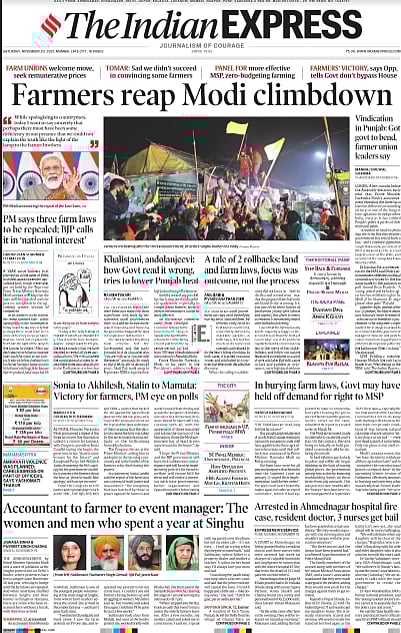
In his usual dramatic style, prime minister Narendra Modi pulled another rabbit from his topi on November 19.

After a year of ignoring the thousands of farmers protesting at the gates of the national capital, demanding the repeal of the three farm laws rammed through parliament by his government, after dismissing their agitation as nothing more than one that was instigated by "andolan jeevi", people who live for protests, he conceded. The laws are being repealed.

While the debate after the announcement has centered on the motives behind the climb-down, and the lessons all political parties can derive from the determination shown by the farmers, another question that must be asked is what lessons the media can learn from the way we covered this remarkable, and historic, civil movement.

With a media obsessively focused on “breaking news” and dramatic events, something as long lasting, and peaceful, as this protest poses a challenge precisely because it is not one, or even a series of events. It is the result of processes that include the state of agriculture and decades of frustration.

When we look back at this year, what viewers and readers are likely to recall in relation to the farmers' protest is a handful of events, such as the standoff between the Delhi police and some of the farmers on Republic Day this year, and how one group climbed the ramparts of the Red Fort in Delhi and raised a flag. Or images of traffic jams on the day the Samyukta Kisan Morcha called for a nationwide bandh.

The result of this kind of bits-and-pieces reporting is that only the spectacular, the violent, the confrontationist, remains in memory whereas the core of this remarkable movement might be erased from public memory.

What will be forgotten, because it was barely reported, was the amazing diversity represented in those who stayed the course over this year. They were women and men from several states, not just Punjab. Many came to show their solidarity. Yet many stayed on. Their stories are worth recording. A few diligent reporters, mostly outside the mainstream from independent digital platforms like Newslaundry, have done just that.

Also, early on the protesters were clear that they could not depend on mainstream media to tell their story. So, they set up their own digital website, Trolley Times.

There were so many stories to tell: the way this protest was organised, that it remained peaceful, that people were fed and housed, that medical aid was available, as this piece by Priya Ramani illustrates.

And let's not forget the women. They were not just helpers, making rotis and being in the background. They assumed leadership roles that only a few in the mainstream media noted.

Fortunately, after Modi's announcement, some in the media made an effort to provide adequate background to readers. The most notable was the November 20 edition of the Indian Express that reported not just the announcement but also provided readers with background of all aspects of the struggle.

And, of course, Ravish Kumar in his primetime programme on NDTV India, who gave us the visuals that we should always remember, including the extent to which the Delhi police went to prevent the protesters from entering the city by digging up the road, embedding spikes, and barricading them with huge containers.

It is not always easy to report on something that continues for so many months. How do you find new angles? Besides, how many media organisations are prepared to assign such movements as a legitimate beat for their reporters? I had discussed in a previous column, marking 300 days of the farmers' protest, the challenges journalists face in covering large civil society gatherings.

A similar challenge faced us decades ago when we reported on one of the longest civil society movements of recent times: the struggle against the big dams on the Narmada River and, specifically, the Sardar Sarovar Project in Gujarat.

The movement, the Narmada Bachao Andolan, was launched in 1985. It began with demanding proper rehabilitation for the people who would be affected by the dam. But in the face of refusal by the Gujarat government to even discuss this, it went on to oppose the construction of the dam.

The NBA successfully mobilised the tribal communities that would be most affected. It also asked questions about the environmental costs of the dam that would submerge many hectares of primary forests. The movement was one of the first to question developmental policies from the environmental perspective. Until then, large and grandiose projects were celebrated as great achievements in a developing country.

For the journalists covering this movement, there were many dimensions that needed to be understood. The perspective of the tribal communities who would be most affected by submergence, for instance. These were people who had lived for decades with developmental neglect such as lack of roads, medical care, education, sources of livelihood, etc. What little they could eke out from their lands and the forests was also being taken from them.

The counter story was India's need for electricity and water for irrigation. It was argued that only if projects were built on this scale could this be done and the collateral, in terms of submergence, was unavoidable.

This was a time when print dominated the media. We did not have 24/7 news channels. Hence, reporters and photographers had to tell this story. And like the farmers' protest, although there were a few dramatic events, the main story consisted of understanding and reporting on the reasons for the resistance, the extent of the impacts of the project, and the stands taken on both sides.

The movement, led by Medha Patkar and her team, did not succeed in stopping the Sardar Sarovar Dam from being built. But the protests drew international attention, and led to serious rethinking in the World Bank about funding such projects in the future.

The fact that even mainstream media houses sent out reporters and photographers to cover this protest played no small role in this. Without that kind of documentation, the movement might have been restricted to the specific areas where people had been mobilised, mostly well away from media centres.

When we look back, it is striking how many journalists followed the story over many years and their news organisations gave them the space to do so. It was an education in how the other half in this country survives. Going to those sites of submergence, seeing the conditions in which the tribal communities lived, understanding their continual struggle for basic survival was a lesson in understanding poverty and misguided developmental policies.

The tragedy is that even those villages that escaped submergence in these tribal districts, because they were on higher ground, continue to suffer neglect in terms of basic health care, education or road connectivity. In all these decades, little has been done to change this reality.

In this 2015 article, "Chronicle of a struggle retold" in the Hindu, sociologist Shiv Visvanathan beautifully encapsulates the decades of struggle by the NBA. He writes, "If you were to ask a middle class person today what the most significant act of history in India of the last 20 years is, most would say this – the rise of Narendra Modi. But to me, the most important historical event of the last two decades has been the battle over the Narmada dam."

The article is a calendar of events starting in 1961 when Jawaharlal Nehru laid the foundation stone of the Sardar Sarovar Project to December 2000, when 350 people trying to present a memorandum to the Chief Justice of India in Delhi about the project were arrested. The most memorable was the Narmada Sangharsh Yatra in December 1990, which was stopped by the Gujarat police at Ferkuva on the border of Madhya Pradesh and Gujarat. For those, including journalists, who want to get a glimpse of this long and peaceful civil society movement, Visvanathan's article is a vivid summary.

The lands and the forests of the tribals who lived on the banks of the Narmada are gone. The benefits of the irrigation and electricity generated by the project have not accrued to them. But their story has been documented – in films, in books, in newspaper articles.

The farmers who are protesting are not leaving yet. But their story, and that of their movement, awaits similar documentation. Doing this is not being partisan. It is what we ought to be doing. Recording history as it takes place, so that future generations will know why and how thousands of women and men, who grow the food we eat, chose to sit it out on New Delhi's borders in the heat, in the rain, in the cold for a year.