Saturday, March 18, 2023

Despite new focus, media misses the darker story about women in sports

 Broken News

Published in Newslaundry on March 9, 2023

Link: https://www.newslaundry.com/2023/03/09/despite-new-focus-media-misses-the-darker-story-about-women-in-sports


While mainstream media continues to focus on games politicians play, this column will focus on the games women play, as in cricket, tennis, football, hockey, athletics, etc., and how the media covers their struggles and achievements.

International Women’s Day (IWD) has just gone by and women in India are being praised, their successes celebrated even as they continue to be targeted for consumer goods, or continue to suffer ‘mansplaining’ as erudite ‘experts’, usually all men, hold forth on what should be done to promote women’s WDequality. All of this has become an annual and rather predictable ritual.

But even this ritualistic acknowledgement of one day for women was not the norm earlier. In fact, I can recall in the mid-eighties, when I worked for a national daily newspaper, trying to persuade my editor to carry an editorial to mark the day. This was a time when Indian women’s groups were on the streets demanding changes in laws that affected women such as rape and dowry. To his credit, the editor did agree that the day was worthy of an editorial comment. 

Now, although IWD is readily acknowledged, for the rest of the year, it would appear that no day is women’s day as the majority of Indian women continue to fight against misogyny, sexual harassment at the workplace, violence in their homes and on the street, unequal pay, low employment, poverty and much more.  

Yet, some things are changing, slowly. One cannot help but notice the sudden spurt in coverage of women in sports in the print media. Has the media suddenly woken up to the fact that these women also deserve attention? More likely, however, the attention is a consequence of big money finally backing some women’s sports, such as cricket.

There’s little doubt that the Women’s Premier League has catapulted women’s cricket to the top of the sports pages. Women have been playing cricket for a while, and doing well. But rarely did they get the kind of media attention they are getting today. 

Before the WPL, the U-19 Women’s cricket team won the World Cup. The Indian Express wrote about their victory in their lead story on the sports page with an unfortunate headline.

“First Ladies”. Ladies? Really? These are determined and plucky women who have fought to play a sport they love and excelled in it. “Ladies” is hardly the appropriate way to describe them. 

Fortunately, the rest of the page told a different story as reports about individual players revealed that most of these women came from so-called “humble beginnings” (a cliché that has been bleached of all meaning). Not only did they struggle to find financial resources to train but they also had to fight the embedded misogyny in Indian society that holds back young girls from pursuing their dreams such as recounted in this story about bowling all-rounder Archana Devi.

Archana’s story exemplifies in many ways the story of women’s sports in India today. Unlike individual sports like tennis or badminton, team sports like hockey, football, and cricket as well as athletics attract women from less-privileged backgrounds. Each story you hear after they succeed speaks of their struggle to first overcome familial opposition, then convince a sports association to give them a chance.
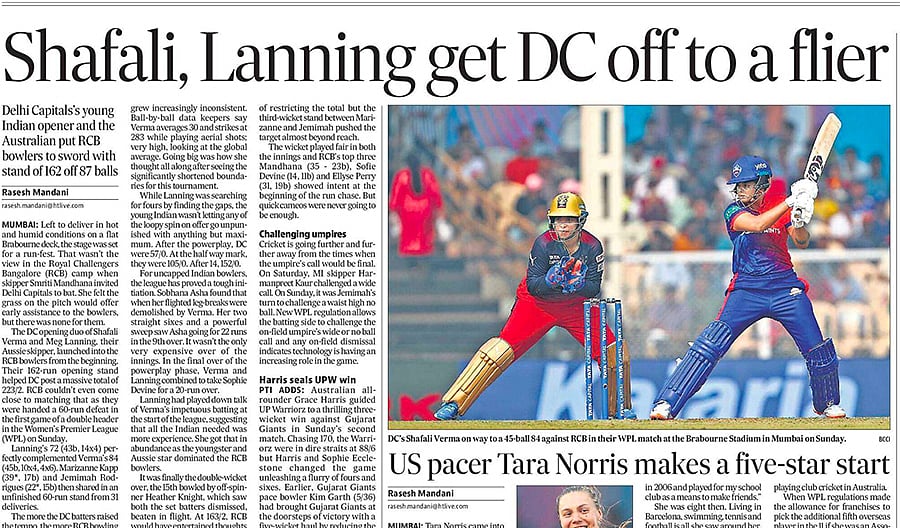
In this important story on women’s sports, Shivani Naik of Indian Express, writes about the results of a recent survey of women in sports. It revealed that sports women had to overcome “poor access to sports facilities, no equipment to play, having to travel more than 10 km to reach the facility, safety concerns, lack of preferred female coaches, unsafe travelling to tournaments and discrimination in sport”. Apart from this was the perennial issue of lack of toilets and even safe drinking water.

In Bihar, women athletes who chose to wear shorts while training as they were more comfortable rather than salwars had to contend with men who “would surround the group and stare, which could get intimidating”. 

These are stories that need to be excavated and reported by the media. They are a necessary reality check on women’s sports in India. While the individual stories of the women who succeed are important, as they play a role in encouraging other women who dream of making a career in sports, the difficult conditions sportswomen face once they have taken the first steps, also need to be highlighted.  

Apart from this, there is also a darker story about women’s sports that emerges occasionally, and then disappears.

This year, the sensational accusations made by leading women wrestlersagainst the head of the Wrestling Federation of India, Brij Bhushan Sharan Singh, once again forced open the hidden world of sexual harassment in sports. There have been numerous other instances reported over the years. Some of them have received passing attention from the media but not enough to compel those in authority to act. This time, the women wrestlers who are speaking out will not be silenced. 

That these young women who come away from their homes for training in various sporting facilities are vulnerable goes without saying. As this editorial in The Tribune points out: “Young female athletes, often coming from an underprivileged background and staying at a sports training centre far away from home, stay silent as sports federation officials and coaches possess complete authority over their career and future. In team events, this can lead to the axing of a sportsperson who spurns the advances of a coach or an official; in individual sports, such a strong-willed player can be penalised citing indiscipline or lack of fitness.” 

Also, as Anupriya, a former cricketer writes in this article in Scroll, “Due to the historical ties of powerful politicians to sporting bodies, and the revenue sports provide to media institutions, there is almost an incentivised culture of hushing up whistleblowing. Indian athletes will always be vulnerable because the very nature and structure of sports rely on conforming to established norms and existing within the ecosystem.”

Sharda Ugra, one of the first women journalists to cover sports, reminds us how even when sexual harassment charges surface, they are addressed or rather not in this article in espncrickinfo. She refers to a 2018 incident when two women cricketers complained about the inappropriate behaviour of a senior Board of Control for Cricket India (BCCI) official. 

Ugra writes: “The whole exercise, undertaken with correct protocol and procedure, was, however, pitted with mishaps and missteps, in deed, language and public perception. It could become a case study for every corporation in the public eye as to how not to behave when attempting to follow the rule book in response to allegations of sexual harassment against their top brass. A case study also on why women in any industry find it hard to lodge any formal protest against powerful men in their business.”

Perhaps it is expecting the impossible to believe that a media, fuelled by the same corporations that back some sports, would be willing to expose the way these sports federations, often run by powerful politicians, deal with issues like sexual harassment. But after the attention drawn to the issue by the women wrestlers, I would suggest that this is a story that needs more media exposure.

Also, this would be an appropriate time for the media to introspect about the way women’s sports have been covered so far. In the past, coverage has swung between outright misogyny, where the only interest in women who played sport was in how they looked or dressed, to one where they got sporadic attention when a team, or an individual, did well. Today, despite a spurt of interest in women’s sports, for the most, sports pages continue to be dominated by men’s sports, including coverage of even minor tournaments. Surely this must change.

Monday, March 06, 2023

From tsunami to Turkey earthquake: The role of media during natural disasters

 Broken News

Published in Newslaundry on February 23, 2023

Link: https://www.newslaundry.com/2023/02/23/from-tsunami-to-turkey-the-role-of-media-during-natural-disasters


Long after the rubble has been cleared, there remain stories that still must be written. Not just of lives lost, of injuries and damaged structures, but of the fault lines in our societies that show up in the wake of a natural disaster. 

For those of us who have witnessed earthquakes in India and reported on them, the coverage of the devastating serial earthquakes that struck Turkey and Syria earlier this month brought back many memories. The details are different, but the trajectory of events is similar. As also the aftermath. 

The coverage of the earthquake’s impact in southern Turkey and Syria has posed many challenges for the media.  Even with the best of technology, how do you report in places with no electricity and poor connectivity, and capture the scale of the tragedy as it unfolds? How do you combine human interest while also respecting people’s right to privacy and dignity in the face of such a disaster? How do you report honestly on the lapses of the government in a country where press freedom has been whittled down drastically?

The challenges that the international, and more so the national media in Turkey have faced carry many lessons for us in India. This article in the Wire by Yasemin Giritli İnceoğlu, a visiting professor at the department of media and communications, London School of Economics, makes many useful observations. She points out, for instance, that the “task of the media is not only to publish updates on search and rescue operations, but also to bring out the failures and errors”, and that “journalism cannot be done without asking questions about lack of equipment, water and electricity; journalists have to hold the powers that be accountable.” 

Yet, in Turkey – and, as we know, in India during the recent Covid pandemic – journalists are not encouraged to ask such questions. You risk interrogation or even arrest if you do.

While we can debate how much press freedom we have in India, the Turkish press under President Recep Erdogan is far from free. As this 2019 article in Columbia Journalism Review  points out, the Turkish press was never completely free even under other regimes. Journalists were imprisoned and newspapers critical of the government were shut down. 

But today, according to the author, “The destruction of Turkish media has come full circle. Where journalists once sought to expose what the government was up to, now they act at its behest to expose – even to help prosecute – their common ‘opposition.’ These days, if an independent journalist dares to write anything controversial, whether on social media or, say, to a foreign reporter...They will wait out the next 24 hours with trepidation, praying that Twitter trolls...Will not have chosen to make their statement the hysterical target of the day. Why would anyone risk saying anything at all, let alone reporting?” 

The consequence of this kind of fear is seen in the way disasters are reported.  International media plays out one story, the local media plays out another. While a foreign reporter might quote people saying that help did not arrive in time, a local reporter would be constrained in saying this because it is risky to report anything critical about the government. The people who suffer the consequences of such restricted reporting, of course, are those who are the victims of the disaster.

One of the factors that has emerged in Turkey is the poor quality of construction in some of the cities impacted by the earthquake. We saw the frightening visuals of what would be considered solid brick and concrete structures, collapsing like a pack of cards. This BBC report of buildings in one of the plushest areas in Gaziantep brings out the reality of shoddy construction, how early warnings were ignored, resulting in huge towers in this locality coming down. 

An architect tells the reporter that 65 percent of the building stock in Turkey is at risk. That is a frightening figure. It is also clear from such reports that apart from the builders who could be charged with using poor quality materials for the construction, the corruption in the system that allowed such subpar construction to be passed as safe is also at fault.  

Reading this, one cannot help but wonder what would happen in our cities in India in the face of such an earthquake. How many of the scores of rapidly built towers that now dot the urban landscape have features that will prevent them from collapsing as did those buildings in Turkey? Would any of these structures, often built in open violation of land use regulations and environmental rules, survive an earthquake? This is an opportune time for the Indian media to turn its gaze inwards and look at our own earthquake-preparedness. 

It is also telling that the Indian media chose to report the story from Turkey only after the government sent aid by way of personnel who could help in the rescue operations and, one presumes, accommodated some media teams.  These were the first person reports we read or saw.  But there is often a local politics involved when other countries rush to provide humanitarian aid. Were any of the reporters who flew to Turkey to report even aware of this?

Seema Guha, a veteran reporter, filed this insightful report in the latest issue of Outlook magazine, which incidentally has focused almost entirely on disasters.  She writes that when an earthquake struck Nepal in 2015, the government rushed in aid. It also accommodated media crews on the Air Force aircraft that flew in.  But within a week of this help being sent, Guha writes, “the appreciation turned into resentment. This had much to do with Indian media’s loud proclamation of New Delhi’s stellar role in the Nepal rescue and relief operations.” 

She quotes well-known Nepali journalist Kanak Dixit saying: “The best kind of disaster aid is quiet and altruistic, with no chest-thumping. India’s assistance during the April 2015 earthquake was prompt, but the way the Indian media tried to take credit for India was unnecessary and took away some of the shine of a good act in the eyes of the Nepali public”.

Good advice, but unlikely to be heeded by much of India’s mainstream media that has become “His Master’s Voice” in every sense of the word.

To conclude, please read this heart-rending piece in Outlook. It is a first-person account by journalist Kavin Mallar of what she experienced as a resident of Nagapattinam, Tamil Nadu during and after the 2004 tsunami. The “after” stretched out over many years. Her story reminds us yet again that disasters don’t end once the rubble and the detritus is cleared.  They are a continuing saga of suffering and survival at so many levels, and of stories that remain untold.  

Monday, February 20, 2023

Why Maharashtra journalist’s murder reflects poorly on status of press freedom in India

 BROKEN NEWS

Published in Newslaundry on February 9, 2023

Link: https://www.newslaundry.com/2023/02/09/why-maharashtra-journalists-murder-reflects-poorly-on-status-of-press-freedom-in-india


Hardly anyone in India, even in Maharashtra, would have heard of a 48-year-old journalist called Shashikant Warishe. On February 6, when Warishe was filling petrol in his two-wheeler in Rajapur, he was “mowed” down, according to newspaper reports, by a vehicle driven by Pandharinath Amberkar. Warishe died the next day from the injuries he sustained.

Warishe’s story is that of many journalists, working away from the glamour and limelight of our metro cities, who diligently report on the excesses that escape the eye of mainstream media. They are the stringers, and the small-town journalists, who file stories about local politics and issues. Warishe worked at a Mumbai-based Marathi daily, Mahanagari Times, and focussed on the people’s struggles in Ratnagiri district against a major oil refinery planned there.

For many years, people in this Konkan belt have opposed the refinery that was originally to be in Nanar village of Ratnagiri district. They opposed it as they feared that pollution from the refinery would impact this largely agricultural and horticultural region, famous for its Alphonso mangoes.  

The previous Shiv Sena government led by Uddhav Thackeray had responded sympathetically to those opposing the refinery by moving it from Nanar to Barsu, in the same district. But that did not end the agitation against it. People in Barsu too opposed it, supported by environmentalists, and Warishe continued to file reports reflecting these voices.

His last report, which appeared on the front page of Mahanagari Times, had images of posters showing Amberkar with Maharashtra chief minister Eknath Shinde, deputy chief minister Devendra Fadnavis and prime minister Narendra Modi. In the report, Warishe mentioned that Amberkar, who actively campaigned for the refinery, was accused of “serious offences”. 

For his journalism, and for reporting on this local struggle against the refinery, Warishe fell afoul of those who would benefit from it being located in the region. One of those was Amberkar, a land dealer who is also a member of the local unit of the BJP.  

The importance of journalists like Warishe cannot be over-emphasised at a time when the Indian media faces serious threats to its independence. It is people like him, close to the ground, who are doing what journalists are trained for: ground reporting that reflects reality, even if it is uncomfortable for those in power. This kind of reporting has virtually disappeared from our Noida-based mainstream television channels and appears only occasionally in a few national newspapers.  

Struggles like the one in Nanar, and now in Barsu, are taking place across this country with local people questioning the location of polluting industries, mines, and many other infrastructure projects. Their voices are barely audible in the cacophony that dominates mainstream media. Yet, ultimately, these struggles ought to be recorded by the media for they give us a true picture of what is going on in the rest of this country beyond the metro cities. 

Warishe’s murder is one more nail in the coffin of freedom of expression in this country. Just days before, on February 2, 43-year-old journalist Siddique Kappan was finally released on bail from the Lucknow District Jail after 850 days in prison. Although his release is a relief, the very fact that he was arrested and remained behind bars for so long reminds us how fraught is the right of journalists to do their jobs.

Kappan’s arrest, on October 5, 2020, by the UP police took place when he was on his way to report on the heinous gang rape, and subsequent death of a Dalit woman in Hathras. That is not a criminal act. Yet, he was arrested and put behind bars on charges ranging from money laundering to terrorism. Kappan reminds us in this interview to Scroll: “I am a journalist. Is it not my job to travel and report? Now, they are going after journalists everywhere.”

Kappan is right. This government is going after journalists who are doing what they are trained to do: report.  Even if one journalist is jailed, the way Kappan was and three Kashmiri journalists (Aasif Sultan, Fahad Shad and Sajad Gul) are, India’s boast of having a free press is seriously dented.

While on the subject of press freedom, let me draw your attention to my last column in which I mentioned a provision the government was contemplating to give the Press and Information Bureau the right to declare what is “fake” or “false” news and get it taken down from digital platforms.

Interestingly, the country to which the chief guest at this year’s Republic Day parade belongs, Egypt, has very similar laws. When the government announced that Abdel Fattah El-Sisi, the President of Egypt had been invited to be the chief guest, few people, including media houses, bothered to look at his record on media freedom. It would have been instructive if they had done so.  

In a detailed report by the Columbia Journalism Review, titled “Sisi’s crusade: One country’s legislative assault of the press”, there is much that echoes what we are witnessing in India today.

For instance, according to this report, “On the one hand, there is the appearance of legitimacy, in that spreading false statements is now banned by a constitutional amendment cloaked in democratic language about the need to preserve the country’s ‘national fabric’ and root out ‘discrimination, sectarianism, racism.’ On the other hand, the assault on independent journalism has become furiously brazen. As leaders around the world take aim at ‘fake news,’ Egypt’s efforts may be the most brutal, and the most foreboding.” Sounds familiar?

An Egyptian journalist is quoted as saying that journalists in his country are left now with only one option: “When Sisi talks about something, anything, all media organisations are required to cover Sisi’s ‘brilliance’...The only things that get published are those that the Egyptian government decides on, or the security services. Meaning, I can’t criticise a minister, or disagree with their policies. I can’t say that anyone is oppressed or suffering. I can only say that the ministers are right, that everything they’re doing is right, that Sisi is right, the security forces are right.” 

Again, sounds rather familiar even if we can claim not to have gone as far as Egypt in suppression of free expression. 

The only consolation, if we can even call it that, is that the Indian government is not alone. According to the Committee to Protect Journalists, “imprisoning journalists is just one measure of how authoritarian leaders try to strangle press freedom. Around the world, governments are also honing tactics like ‘fake news’ laws, are using criminal defamation and vaguely worded legislation to criminalise journalism, are ignoring the rule of law and abusing the judicial system, and are exploiting technology to spy on reporters and their families.” 

At a time when political parties are getting into election mode, the fetters on journalists and independent media are unlikely to feature in any election campaign because no political party is vested in ensuring that the media is really free. More reason then that those of us, even if we are a minority, who believe that freedom of expression is a fundamental right, continue to write and speak out for that right.

Monday, February 06, 2023

Modi’s misstep: By banning BBC documentary, far more people have now watched it

 Broken News

Published in Newslaundry on January 27, 2023

Link: https://www.newslaundry.com/2023/01/27/modis-misstep-by-banning-bbc-documentary-far-more-people-have-now-watched-it


The Modi government has scored a self-goal.

By using emergency provisions in the Information Technology Act to order YouTube and Twitter to take down links to episode one of the BBC’s two-part series India: The Modi Question, the government has ensured that thousands of people have now watched the programme.

The programme was telecast on January 17 on BBC Two, which is only available to viewers in the UK. Yet, given the nature of the internet, it was widely available on social media in no time for anyone anywhere to watch it.

Two days after the first episode was telecast in the UK, India’s external affairs ministry spokesperson Arindan Bagchi said the documentary was a “propaganda” exercise that reflected a “colonial mindset”, and that the government had taken the step to get all links to the episode taken down.

Under the emergency provisions of the IT Act, the government can ask for content to be removed if it affects the “unity, integrity, defence, security or sovereignty of India”. It has been used several times since these provisions were introduced and Twitter has acceded several times to the government’s requests based on this provision. In this instance, barring Bagchi’s statement, the government has not issued any explanation about how this programme falls under any of these categories.

The first episode focused on the communal killings of 2002 in Gujarat when Narendra Modi was chief minister. Its news peg, so to speak, was a confidential report prepared at the time by the British high commission in India on the events that unfolded in the state. According to the report, which has been published on the Caravan’s website, the team that went to Gujarat concluded that Modi was “directly responsible”. 

For those familiar with what happened in 2002, there is little that is startlingly new in the programme, barring the British high commission’s report. We see distressing footage of those days and weeks in Gujarat that are familiar to many who watched the events unfold on live television, as India had private TV channels by then that covered the killings. There have also been films like The Final Solution by Rakesh Sharma that recorded the events of 2002.

The producers of the documentary have ensured that both critics and supporters of Modi have a say, giving the former plenty of airtime to put forward their views. There is also a mention of the Supreme Court clearing Modi of all charges of conspiracy.

Then why object to the programme? It’s evident that any reminders of what happened in Gujarat in 2002 are not welcome, even if they are by a foreign channel with a limited audience, now that Modi is the prime minister. If the government thought the documentary would sully Modi’s image internationally, especially when India is chair of the G20, the decision to take it down has misfired. Leading international outlets – including the New York TimesWashington PostTimeGuardian and others – have questioned the Modi government’s commitment to freedom of expression. Hardly appropriate at a time when the government has claimed that India is the “mother of democracy”.

Apart from individuals viewing the banned episode, there have been attempts at public screenings. But by overreacting to such screenings at Jawaharlal Nehru University, where the power went off just as the screening was to begin, or detaining students who were organising screenings at Jamia Millia Islamia, the government is only adding more fuel to the fire it has lit. 

There are likely to be even more acts of defiance, and the debate over the documentary is likely to continue for some time. In some ways, the government has done us a favour. It has drawn the attention of the public to these emergency provisions that have a direct impact on freedom of expression.

Incidentally, so far, the government has raised no objection to the second episode of the series. This looks at what has happened since 2014, when the BJP came to power at the centre and Modi became prime minister. Its specific focus is the status of Muslims in India today and, over the course of one hour, it records the lynching of Muslim men, the impact of the National Register of Citizens on Muslims in Assam, the opposition to the Citizenship Amendment Act, the Delhi riots of 2020, and the reading down of article 370 in Kashmir. Together, this makes a powerful indictment of the policies of the current government. 

One of the most chilling sections in episode one is the interview by BBC correspondent Jill McGivering with Modi in 2002. It concludes with this exchange. McGivering asks, “Do you think you should have done anything differently?” Modi responds: “Yes. One area where I was very, very weak. That was how to handle the media.”

The Modi who is now the prime minister of India has figured out how to handle the media. 

The provisions of the IT Act that the government used to order the taking down of links to the BBC programme are only one of several steps that this government has taken in the last eight years. They are incremental, like a slow burn. Hence, the response to them has been muted, limited to statements by media organisations and some editorials.  But the cumulative impact of these measures has been to try and stifle freedom of expression.

The government’s latest move to control the media is a draft proposal amending the IT Rules that will give the Press and Information Bureau the power to determine what is “fake” or “false” news and demand that it be taken down. The draft has not yet been accepted and several media organisations, such as the Editors Guild, have issued strong statements against it. As a result, the deadline set for objections has been extended. Whether these objections will be taken on board remains to be seen.

 However, the very fact that this government can contemplate such an amendment, essentially allowing a government department to decide what is “fake”, with little recourse to a hearing before the action is taken, indicates a larger plan to control free expression.  As the Indian Express points out: “...to remove content merely because the government decrees it ‘false’ would restrict free expression without any constitutional justification, violating citizens’ rights to receive all information on public issues, whether true or false.”

Incidentally, for those of us who were journalists during the Emergency of 1975-77, and had a direct experience of press censorship, it was the same PIB that operated as censor under orders from its political bosses.  Although today we are not living under an Emergency, to institute a system that gives such powers to a body whose principal job is to put out information about government programmes is ominous, to say the least, and totally unacceptable under any criteria of press freedom.

Unfortunately, as I have mentioned earlier, such incremental steps are like a slow burn. The public does not realise how gradually these curbs are being put in place. It is a perfect strategy to lull people into believing that we live in a free country, with guarantees of free expression, even as this right is being stifled slowly and surely. 

Monday, January 23, 2023

Joshimath’s story dates back decades. That’s why media must dig deep

Broken News 

Published in Newslaundry on January 12, 2023

Link: https://www.newslaundry.com/2023/01/12/joshimaths-story-dates-back-decades-thats-why-media-must-dig-deep


A small town in Uttarakhand has made it to the front pages of newspapers, and as the top story in many television news shows. Joshimath, a town of a little under 17,000 people in Chamoli district, is already well-known to trekkers, those wanting to explore the Himalayas, and Hindu pilgrims. But today, its claim to fame is that it is sinking.

It is also in danger of becoming an adjective – a descriptor of what happens when we ignore concepts of sustainability as we pursue so-called “development”. 

Predictably, when the cracks in Joshimath’s buildings could no longer be ignored, the government moved on a “war footing”, as did the media. We watched videos and saw visuals of distressed residents pointing to huge cracks in their homes, read about a hotel tilting onto another, and listened to experts who said they knew this crisis was imminent.

Yet, the roots of the current crisis – of a town literally sinking – have probably not yet sunk in, either to the lay media-consuming public with an increasingly diminishing attention span, or to the people who pushed through plans to build power plants and blast the fragile mountains for roads, despite adequate warnings from experts. 

There is a message here for the media – a message it continues to ignore. Even if you report on a disaster, integrate the perspectives that explain the reasons for it. It’s not difficult to do this. And if it’s done, chances are that more people will understand why many of the projects being pursued in the ecologically fragile environment of the Himalayas spell disaster.

Of course, as always, there are exceptions. Newspapers and digital platforms have carried excellent explainers that an interested reader can plough through (see here and here). But useful as this is, it is not enough. The facts tracing this disaster to earlier policies are clear. They need to be repeated, they need to be integrated in the reporting. 

Few can explain more simply than Dehradun-based veteran environmentalist Ravi Chopra, who headed the high-powered committee looking at the environmental impact of the Char Dham project in Uttarakhand. He resigned last February because their recommendations were ignored. Read his interview in Down to Earth and his op-ed in Hindustan Times that say all that needs to be said. 

Another article in Down to Earth also reminds us that what’s happening in Joshimath today could happen in a number of other towns in Uttarakhand, including the popular tourist resort of Nainital, before too long. The reasons are the same: unsustainable development that pays no heed to the carrying capacity of the natural environment.

The new year has begun with another environment-related story on the front pages, one that gives all of us a sinking feeling. In 2021, of the 50 most polluted cities in the world, 35 were in India. The situation today is likely to be no different, perhaps even worse. Not just Delhi, but in dozens of other small and big cities in this country, residents are choking from poisonous air. You don’t need a viral infection to get lung congestion these days. You only need to breathe the air.

According to the World Health Organisation, 90 percent of the world’s population breathes air that is worse than acceptable limits. But within that, it is people in low- and middle-income countries like India that suffer the most. In any case, India has diluted WHO standards for air quality although revising them is being discussed. At present, what is considered “good” air quality here in India is actually “moderate” or even “poor” air quality according to WHO standards.

Like the Joshimath story, the reports we read do not adequately explain the current air pollution crisis in India. Even as the air quality index climbs higher in city after city, there are some reports explaining the possible reasons: vehicular pollution, construction dust, industrial pollution, etc. 

The factors contributing to air pollution, such as vehicular pollution, have been known for decades. Most readers today would not be aware that in the 1990s, one man fought determinedly for a change in the fuel used in public transport in Delhi. That was Anil Agarwal, who set up the Centre for Science and Environment. The air pollution levels in Delhi at that time were nowhere as bad as they are today. Yet, Agarwal, who suffered from chronic asthma and later succumbed to cancer, campaigned through CSE for a change in fuel used in public transport in Delhi from petrol and diesel to CNG. Several other cities implemented this in later years. The 2010 CSE report, Slow Murder: The deadly story of vehicular pollution in India, is worth revisiting even today.

But despite campaigns by CSE and other environmental groups about the polluted air in our cities, there is little to no outrage about the many projects being implemented that do nothing to address the problem. Instead, more roads are being built to accommodate a greater volume of vehicular traffic using fossil fuels, there is little to no compulsion on the building industry to implement dust alleviating strategies, and the system to keep a check on levels of pollutants emitted by industries and thermal power stations in the vicinity of cities remains impaired despite decades of debate about it.  

Every year during the winter months, we see photographs showing us what we can see when we look out of our windows. Yet those with the power to take hard decisions – such as suspending all construction activity during the worst days, or restricting vehicular movement – choose to ignore what stares them in the face and invades their nostrils as much as those of ordinary citizens. Could this be because there is no public outrage?

Unlike in Joshimath, where the buildings with cracks face demolition, and the anxious and angry owners of these structures are out on the streets protesting, India’s urban residents seem to have accepted a slow death from poisonous air with apparent equanimity. 

One reason for such a passive response can be attributed to the class factor. The people most affected by the poisonous air quality are the homeless and those who are compelled to do outdoor physical labour – basically the poorest in our cities whose voices are rarely heard. The better-off have windows they can close, with air-conditioning in their cars and homes that allows them to insulate themselves. Possibly, this is one reason why the problem of air pollution has rarely moved the powerful, nor led to drastic changes in the way we view urban development. For instance, as Shoaib Daniyal points out in this article, bus commuters who are the majority in any city rarely get their voices heard over private car owners. 

In this gloomy scenario, here’s a suggestion for the media. What if in all the 35 cities on the top of that list of polluted Indian cities, local newspapers, radio stations and TV channels ran a daily count of not just the poor air quality, but of the number of people hospitalised and dying from respiratory infections? In the last three years of the pandemic, many media outlets did this, tabulating daily the number of people afflicted, hospitalised, or dead due to Covid. Surely, such a proactive step by the media would play a significant part in building up public opinion that could then put pressure on decision-makers to act. 

That’s another item for my wish list for 2023.


Tuesday, January 10, 2023

Backward districts, health infra: What mainstream media reportage can help change in 2023

 Broken News

Published in Newslaundry on December 29, 2022

Link: https://www.newslaundry.com/2022/12/29/backward-districts-health-infra-what-mainstream-media-reportage-can-help-change-in-2023

The end of the year usually leads to reflections on the year gone by. But let me break with tradition and instead set out a wish list for the kind of coverage we can hope for in the coming year. This could be wishful thinking given that 2023 is an election year with nine states going to the polls. But there’s no harm in hoping.

Even as the media is as usual dominated either by politics or, as in the case of TV news, nonsensical controversies – such as the saffron bikini drama – manufactured out of thin air to get eyeballs, there are some stories that somehow break through. It’s possible that only those of us interested in these issues read them (here I refer to print and the online portals). Yet, the very fact that a few stories of the kind I am going to highlight make it into print, gives us some hope that all is not lost.

The Mumbai edition of Indian Express has started a series on health care in rural Maharashtra. With the possibility of Covid once again rearing its head in India, health infrastructure is a relevant subject as we know from our experience of the last three years. As the redoubtable Dr Gagandeep Kang, Professor, Christian Medical College, Vellore has repeatedly reiterated, healthcare systems that are already stressed perform badly during an emergency – such as the pandemic we have lived through.

For rural India, the absence of adequate health infrastructure has been a tragic reality even as India struts on the global stage claiming to be a power that the world should reckon with. We remain mostly unaware of the extent of the health crisis in much of rural India because, in recent years, mainstream media has turned its attention away from such issues. 

The series in Indian Express, by Rupsa Chakraborty, begins by focussing on one of the poorest districts in Maharashtra, Nandurbar. Some parts of this district touch the banks of the Narmada river, and many Adivasi-dominated villages in this district were submerged in the backwaters of the Narmada following the construction of the Sardar Sarovar Dam in Gujarat. The story of their struggle for adequate compensation and relocation is well-known. 

The villages that escaped submergence continue to suffer much of the developmental neglect that affected those that had to move. For instance, even today, as reported by the Indian Express, levels of malnutrition and the number of severely malnourished children are higher in Nandurbar than in other districts in Maharashtra. The situation was no different in 1984 when I, then working in the Mumbai edition of Indian Express, first heard about Nandurbar.

Chakraborty assesses the state of the 11 primary health centres set up in the district in the last two years at a cost of Rs 6 crore each. They were brand new two years ago. Today, she writes, their condition is “abject”.

The one she visited in Bilgaon, inaugurated just a year ago in 2021, lacks basic infrastructure like electricity. The medical officer treats his patients using a torch once it is dark. This PHC covers 11 villages with a population of 14,221. The nearest alternative, a better equipped facility at the sub-district headquarters, is 104 km away.

Not just electricity, there is often no water either. After it was inaugurated, the PHC received water from a tanker. But this stopped well before a water connection was installed as late as September this year. Apart from these basic infrastructure deficiencies, the PHC is also poorly staffed, a depressingly familiar story. 

Apart from these PHCs on land, several villages on the banks of the Narmada were supposed to be served by floating dispensaries and water ambulances. Their state is not much better, as described by the reporter. 

She writes, “Over a decade ago, the state government had launched two floating dispensaries to provide healthcare to nearly 20,000 tribals residing in 33 hamlets – inaccessible by road along the Narmada river. These tribals were displaced during the construction of the Sardar Sarovar project…More than a decade later, one of the floating dispensaries has broken down beyond repair and presently lies in a godown. The other, around 20-ft long, is in a rickety shape, with medical staff as well as patients afraid to board it scared that it may capsize any moment.”

The point about narrating these details is that even though the stories are about a particular part of India, they reflect the reality in many parts of this country. Even during the pandemic, although there was some reporting from rural areas, it was inadequate. Most of the focus was on urban India where the media is based. As a result, even today, we don’t have the full story on how people – such as those living in districts like Nandurbar – dealt with the pandemic.  

The last three years have clearly established the need for well-trained health reporters who can understand the science, but also the politics and the economy of health care. For instance, more probing questions need to be asked not just of the government but also of the pharmaceutical industry. And editors need to back reporting that requires going to areas away from the limelight, such as these backward districts, that tell us the real story of disease, health care and survival. 

There are, of course, many more areas that mainstream media should investigate. But to start with, it could look at the state of health care and health infrastructure in India’s most backward districts. Even if the authorities don’t instantly respond to such stories, media scrutiny and civil society pressure represent the only hope for things to change for people living in these areas. 

I cannot end this last column of 2022 without once again reminding readers about journalists who are still in jail. Siddique Kappan, who was arrested in 2020 on his way to cover the gangrape, and subsequent death, of a Dalit woman in Hathras, UP, has finally got bail. But as of writing he continues to languish in jail.

And in Kashmir, Fahad Shah, editor of Kashmir Walla, Sajad Gul from the same publication, as well as Aasif Sultan of Kashmir Narrator, are still in prison under the draconian Public Safety Act.  

A senior Kashmiri journalist told me that up to 50 Kashmiri journalists have had to leave Kashmir and go elsewhere looking for jobs because workinSg in the erstwhile state has become virtually impossible. A Kashmiri journalist told the Committee to Protect Journalists that the media in Kashmir “has reached a breaking point, where journalists are wondering whether it’s worth it to report from Kashmir”.

This then is the other reality that we must remember, and repeatedly highlight, as we go into 2023. We cannot speak of freedom of the press so long as journalists are behind bars just for fulfilling their professional commitments as reporters. Journalism is not a crime.


Tuesday, December 20, 2022

In rare reports on the Adani empire, a reminder of independent media’s significance

 Broken News

Published in Newslaundry on December 15, 2022


Few would have heard the name of TV journalist Govind Wakade. He works for TV18 and is based in Pune. 

Wakade went to cover a function at Pimpri Chinchwad on December 10 where a Maharashtra government minister from the Bharatiya Janata Party, Chandrakant Patil, was speaking. During the meeting, someone in the audience was incensed enough at a remark made by Patil to hurl an inkpot at him. The moment was captured by Wakade on his camera. The clip was shared widely on social media.

The next day, on December 11, Patil claimed that the attack was planned and demanded an investigation. As reported here, he went further by asking: “How did that journalist get the exact angle when the ink was being thrown at me? Who is that journalist? If by tomorrow morning, this journalist is not traced, I will sit on a fast at Pimpri police station.”

The police responded promptly by finding Wakade and summoning him to the police station for questioning. They did not, however, arrest him.

This incident, and the minister’s comment, exemplifies the attitude of those in power towards the media. It also illustrates the reality of press freedom in India, tenuous at the best of times. Today, journalists are at risk even if they are simply doing their jobs, of recording events and reporting them.  

How did we descend to such depths? The annual report by Reporters Without Borders (RSF) on the media landscape in India is scathing.  The government, of course, will ignore it, as it has in previous years. Why should it care that India is ranked 150 out of 180 countries on the World Press Freedom Index? All that matters now, it seems, is that India is heading the G20!

The RSF report, however, is worth more than a passing glance. It calls India “one of the world’s most dangerous countries for the media” with “an average of three or four journalists killed in connection with their work every year.” 

Apart from flagging the violence that journalists face, and the very real possibility of arrest, the report also mentions the concentration of ownership in mainstream media. This is often overlooked in discussions about media freedom, but as we are seeing, when media owners and those holding political power come together, the idea of a free press becomes something of a mockery.

To quote from the report again:

“The Indian press is a colossus with feet of clay. Despite often huge stock market valuations, media outlets largely depend on advertising contracts with local and regional governments. In the absence of an airtight border between business and editorial policy, media executives often see the latter as just a variable to be adjusted according to business needs.”

“An airtight border” between the business side and editorial began crumbling a while back. I can remember from my time in the Mumbai edition of a national daily newspaper several instances where instructions came directly from the owners to the editors. For instance, reporters on the health beat were told that nothing critical should be reported about a particular hospital because the owners of the publication also served on the hospital’s board. Similarly, a news story quoting from an independent investigation into violation of workers’ rights by a leading multinational in Mumbai was dropped at the last minute because the company representative spoke directly to the owner who then instructed the editor. The newspaper received generous advertising from this company. This was in the 1980s. 

Today, not only are media houses treading on eggshells when it comes to the government, but they are also selective about writing critically about powerful business houses, especially those in complete sync with the current government. You see this every day in the choice of stories mainstream media chooses to highlight, and those it ignores.

On December 12, the Washington Post ran a frontpage story with the headline: “In Modi’s India, an empire built on coal”. It is highly unlikely that any of India’s leading national dailies would have run this story on their front pages, or even inside. The story caused something of a buzz on social media. Yet, those outside the social media realm, and who don’t read international publications, would not know of this investigative report because it was not reflected either by way of a comment, or a report in mainstream Indian media.

The story’s focus is a coal-fired power plant in Godda, in Jharkhand, that is part of the expanding empire of Gautam Adani. It reveals how rules were changed to accommodate the setting up of the plant which is scheduled to supply power to neighbouring Bangladesh courtesy of an agreement between our two countries. 

For an audience outside India, the story shows how India continues to use coal for power generation even as the world is moving away from fossil fuels due to the ugly reality of climate change. In India, the story illustrates how when people holding political power and private business work together, there is no obstacle too great that cannot be overcome. 

In this case, the private business happens to be owned by Gautam Adani, who is, as the Post reminds us, not only “the largest private developer of coal power plants and coal mines in the world”, but also “the second-richest person on the planet, behind Elon Musk” whose earnings have doubled just in the last three years. 

For those who follow some of these issues closely, much of what appears in the Post story has been reported before. The advantage the Post had was that it could cover the Bangladesh angle which an Indian publication would find difficult.  

In 2019, Scroll carried a detailed three-part investigation into the same power plant in Jharkhand. But these reports did not receive the kind of attention that has been accorded to the Washington Post story. 

The reports in Scroll in 2019 by Aruna Chandrasekhar are meticulous in their detail. They are well worth reading because they illustrate the kind of journalism that we need today but is sadly missing because media houses will not invest in the in-depth reporting that brings to light facts otherwise obscured. 

Her reports highlighted how the Jharkhand government, then ruled by the BJP, amended its energy policy in such a way that Adani got a higher price for the power generated. She spoke to the villagers who lost their land to the project, and also reported how converting the project into a special economic zonefacilitated saving of taxes and additional profits to the company. 

Holding the powerful to account does not relate only to the government. It also means the economically powerful, whose interests often coincide with those holding political power, as in the present case. That is why these stories on the Adani empire are so significant. They are also a reminder, yet again, of the importance of independent media, because even the most powerful will not be able to erase the facts recorded in such reports.