Showing posts with label big media. Show all posts

Tuesday, March 18, 2025

From Vantara to forest reserves, photo ops trump journalism

 Broken News

Published in Newslaundry on March 13, 2025

Link: https://www.newslaundry.com/2025/03/13/from-vantara-to-forest-reserves-photo-ops-trump-journalism

Compared to the Trump Tsunami that has the US president literally flooding the media with new and almost always controversial statements every day, our leaders and their politics appear almost dull. 


Even as he announced drastic job cuts in his country and the stock market went into a deep dive, Donald Trump found the time to promote his close friend and confidante Elon Musk’s electric car, Tesla, on the lawns of the White House. The concept of conflict of interest clearly does not exist in the era of Trump that we have now entered. There may be a few parallels in India.


Meanwhile, in India, the stock markets have been volatile. And there are other raging controversies, such as on the language issue and delimitation. But our prime minister seemed unperturbed as he spent a day endorsing the efforts of Anant Ambani, son of Mukesh Ambani, in setting up an animal rescue facility and what some may call a private zoo – Vantara in Jamnagar. 

Modi posed, stroking a lion who was safely ensconced in a glass cage. He was also photographed feeding tiger cubs. And all this promotional material was amplified without a question by mainstream media. There were no queries about the facility, how many animals it had, from where these animals had been brought, at what price, and whether the environment in which they were caged was suitable for them.


One newspaper did raise some questions shortly after Modi’s visit to Vantara. The Telegraph ran a story quoting a report by the Wildlife Protection Forum of South Africa (WAPFSA) which raised some uncomfortable questions about Vantara. Strangely, that story has now been taken down. And the PDF of that report as well as the statement by WAPFSA has also disappeared from its website.


But before that happened, it was mentioned in reports in Down to Earth and in Scroll, amongst other independent portals. 


The PDF of the WAPFSA report, which this columnist accessed before it disappeared, pointed out that Vantara had purchased wild animals from South Africa, some of which were endangered.  


It stated: “According to published articles, between 2019 and present day, the Radhe Krishna Temple Elephant Welfare Trust and the GZRRC have amassed what is described as an extraordinary assemblage of wildlife, including multiple endangered species. GZRRC started, according to the exact terminology of a published article, with an opening ‘stock’ of 1873 animals and during one year 2022 – 2023 acquired a further 1946 animals.” 

GZRCC stands for Greens Zoological Rescue and Rehabilitation Centre, an affiliate of Vantara.


The Down to Earth story also mentions the animals in captivity at Vantara and quotes WAPFSA: “Most wildlife experts agree that placing animals in any captive environment is itself a form of mistreatment. A life in captivity in a zoo, no matter how advanced the zoo facilities may be, can never equal a life lived in natural surroundings. Captivity enforces conditions upon wild animals in which they are not adapted to thrive.” 


Earlier in the year, Deccan Herald carried a story reporting that activists in Assam were worried about the way 21 captive elephants had been transported from Arunachal Pradesh to Jamnagar for the Vantara facility.


But these are exceptions. No questions asked or raised, no effort to get the back story. That now is the dominant norm in most of mainstream media when it comes to anything endorsed by the prime minister or the government.


For instance, after Vantara, Modi visited the 58th tiger reserve in Madhya Pradesh. An obvious question that any self-respecting media organisation should have asked is: how are the other 57 doing?


Tiger sanctuaries were enthusiastically promoted in the 1970s when Indira Gandhi was the prime minister. Project Tiger was hardly ever questioned except by a few journalists and activists. Anil Agarwal, the pioneering environmental journalist who set up the Centre for Science and Environment (CSE), wrote this in “The State of India’s Environment 1982: A Citizens’ Report” about Project Tiger: “Project Tiger is a spectacular landmark in our efforts at wildlife conservation. A serious flaw in this approach, however, is highlighted by the situation in the Periyar Tiger Reserve. Here, several tribal villages were shifted out of the core zone. Dispossessed of their habitat, the tribals soon lost the little land they were given as compensation, and became pauperised. At the same time, the authorities did not remove four cardamom estates in the heart of the core zone”.


Since then, the rights of forest dwellers have found support, and the Forest Rights Act was passed in 2006. The law is not perfect but at least it recognises that forests are not just for animals but also for the people who have always lived there. However, as with so many reasonably good laws in this country, it is observed in the breach. Unless people protest, no one pays heed to such rights, particularly when the people involved are at the bottom of the economic pyramid. 


And of course, only if people come out in substantial numbers on the streets does the media pay any heed to what they are saying.


Agarwal’s observations of the Periyar Tiger Reserve are echoed even today in other tiger reserves. Take this story by The Hindu’s Odisha correspondent Satyasundar Barik on tiger sanctuaries in the state. He points out that not only were the Adivasis forced to relocate but that out of four tiger sanctuaries in the state, one has no tigers and yet vast lands have been emptied out for it.


And this story in Down to Earth points out that even today, literally thousands of Adivasis are being evicted from lands they have occupied for generations by the process of creating inviolate spaces for tigers and other wildlife.  


“These evictions are affecting nearly 400,000 Adivasis, who are now fighting to defend their homes and heritage. Protests have erupted in major tiger reserves such as Nagarhole, Kaziranga, Udanti-Sitanadi, Rajaji, and Indravati. Demonstrators are calling for an immediate halt to what they describe as illegal actions by the government.”


You will not know any of this if you only follow mainstream media. Of course, there was a time when newspapers devoted space to environmental stories, even those that made the government or corporations uncomfortable. But that is in the past. In today’s media reality, the only environment that interests the mainstream is what happens in big cities. So, air quality, and sometimes water quality, will feature as environmental stories.


Meanwhile in the rest of the country, not only are thousands of Adivasis being displaced, but rivers are being poisoned, glaciers are melting, land degradation is evident, and the mad pace of infrastructure construction everywhere is turning cities, and even small towns into dust bowls.


Wednesday, June 19, 2024

Ownership, money, Modi 3.0 uncertainty: A sobering reality check for election cheer

 Broken News

Published in Newslaundry on June 13, 2024

Link: https://www.newslaundry.com/2024/06/13/ownership-money-modi-30-uncertainty-a-sobering-reality-check-for-election-cheer

The Lok Sabha elections will continue to be analysed threadbare for some time to come. They were unexpected, revelatory about the Indian electorate and uplifting, even if momentarily, because they suggested that democracy is still alive in India.


The celebrations, however, by those who believe that the election results, and a governing party with a diminished mandate, will lead to substantial change need to be tempered with a reality check.


Let’s just look at the media, especially television news – call it “mainstream”, “Big Media” or “godi media”. There is little to debate now that in the last decade under Narendra Modi’s government, it has been a supplicant, rather than acting as the Fourth Estate in a democracy.


The clips of the dozens of interviews Modi gave to these friendly channels during the elections are proof enough, if that was needed. News anchors, who on any given day, are in scream mode, were listening and smiling attentively even as Modi proceeded to lecture and even insult the media.


After a decade of bending over backwards to please the ruling party, to amplify its poisonous and hate-filled narrative, especially against Muslims, and to save its aggression for the opposition, can one really expect a change just because the governing party’s numbers in this Lok Sabha are fewer than the last time?


I think not, and this is why.


First, even if the BJP is now more dependent on its coalition partners in the NDA today than it was yesterday, is there any proof that these partners are committed to freedom of expression and freedom of the press? Would they really object if this government – which the media has rightly called “Modi 3.0” rather than the “NDA government” because Modi will continue to dominate – continues to find ways to curb dissent and critical voices in the media? 


As a former chair of Prasar Bharati, Jawhar Sircar points out in this article in The Wire, “The godi media is likely to be a little less virulent against the opposition, as one never knows who may come in next. But the screaming television prosecutors, including a few rotund well-dressed creatures who revel in tormenting anyone who dares to question Modi, would hardly change — as they earn unimaginable amounts of crores.”


Which brings us to the second point, that the owners of these television channels dictate the line they take. And that ownership pattern is not changing.  As long as it is evident that Modi and the BJP are in full control of the government even if technically, they are part of a coalition, the topics discussed might change a little, but the approach will remain the same. There is no cost attached to attacking the opposition, but criticism of this government will still have repercussions.


Media analyst Vanita Kohli-Khandekar, who writes a column in Business Standard, makes some additional and interesting observations about Big Media. She points out that while the Election Commission figures reveal that 642 million people voted in these elections, and of these, roughly 235 million or 36.6 percent voted for the BJP, if you watch any of the roughly 400 news channels, you will think that the news on it is directed only at these 235 million who support the BJP. What about the remaining 407 million news consumers, she asks. 


This gap has been filled to some extent by independent news channels on YouTube and for those who read news, the digital news platforms that are not dependent on big business. Their numbers might not exceed those who watch or read news provided by these mainstream channels and newspapers, but there is little doubt that they have played an important role in the last five years, in filling the void left by mainstream media. They have been the source of nuanced and in-depth reporting, of critical comment, of interviews that inform and educate. 


Their ability to continue and remain independent in the future, however, is uncertain. This Modi 3.0 government might wait a while before it proceeds with the agenda it outlined in its previous avatar but there is little doubt that at some stage it will find ways to curb independent media. 


For instance, even before the first sitting of the new Lok Sabha, Mohammed Zubair of AltNews has been informed that the Delhi Police has asked that his account on X be taken down because it violates the Information Technology Act.  The social media platform has not complied with the request but the very fact this has happened within days of the formation of the new government provides a necessary reality check on its approach towards a free and independent media.  


We must remember that there are two interventions that will adversely impact independent media that are still on the anvil. One is the setting up of a “fact-checking unit” that will determine what is false or misleading and insist it be taken down by social media platforms. And the other is to bring all news-related YouTube channels under the Broadcasting Services Act which will give the government the power to curtail their content.


Journalist Charmy Harikrishnan sums up the last decade under Modi well when she writes:


“This was a lost decade of journalism. A generation of journalists has come of age with the bitter knowledge that the only news that is fit to print is positive news or spin. It is time we looked at ourselves in the mirror and flinched. It is time we wrote an editorial to ourselves. It is time we rediscovered the 5 Ws and put them to every announcement the government makes instead of responding with 1 Yes. It is time we redeemed ourselves.”  


Until this Modi 3.0 government settles back into its bad old ways with respect to independent media, there has been a welcome breathing space. This has permitted some interesting comment and analysis as well as much-needed humour and parody of India’s most powerful man.


The best is the cover of the latest issue of Frontline magazine, with a cartoon by Satish Acharya. It says all that needs to be said.


Also, much of the debate on TV, especially after the exit polls of June 1 that were way off the mark, took away from a more nuanced understanding of what had happened on the ground in these elections.


For those who wanted to know, The Hindu ran the post-poll survey by the Centre for the Study of Developing Societies (CSDS) over several days. Equally useful and interesting is the interview by Manisha Pande of Newslaundry with Sanjay Kumar, the director of CSDS. The interview is worth watching because it answers so many questions that people must have to understand what has changed in India to throw up these results.


And finally, let me end by mentioning what I consider one of the most heart-warming articles to appear post-results even though I am not as optimistic about the future. Written by well-known cultural activist and literary critic G N Devy in The Telegraph, it is addressed to the Indian voter:


“Political analysts may lose sight of the fact that Indians are heaving sighs of relief not because their respective parties have won or lost but because they know that democracy has recovered from a spell of authoritarianism and the cult of personality… Leaders drunk on power, reeking of arrogance, need to know that as they were giving their lectures, thumping their chests, abusing their adversaries, pandering lies and posturing as superhuman, Indians were watching them without giving even the slightest clue as to which way their thoughts were going.”


The clues were there, given by independent media, but these leaders were not watching.


Sunday, February 18, 2024

Beyond PM’s front-page guarantees, silence on Ladakh, and threat to digital media

 Broken News

Published in Newslaundry on February 9, 2024

Link: https://www.newslaundry.com/2024/02/09/beyond-pms-front-page-guarantees-silence-on-ladakh-and-threat-to-digital-media


The prime minister has spoken. He speaks all the time, but when he decides to speak in Parliament, we are compelled to listen. It is an institution that he visits infrequently. However, given that the 17th Lok Sabha is winding down as we face a general election, we must pay heed to his words. 


Apart from the predictable rhetorical flourishes for which the PM is now well-known, what continues to amaze those who care to listen carefully is his skill at proclaiming half-truths, or even untruths, as unquestionable facts. 


Electoral politics is a battle of perception, and visibility. And we have seen in the last decade how Narendra Modi, and the Bharatiya Janata Party have mastered this. 


Given that Modi has been the prime minister for a decade, everything and anything he says or does is news. In addition, he has a dedicated space on radio for his Mann ki Baat monthly programme, and even a YouTube channel.


As if this was not enough, we have been deluged with daily front-page ads in leading national newspapers. Without fail, at least one national newspaper will display below its masthead on the front page an advertisement that has Modi’s face and the words “Modi Sarkar ki Guarantee”. The ad boasts of schemes launched by the government that have apparently been brilliantly successful. 


As these are advertisements, there is no space to question the so-called facts stated in them. But just below the advertisement is often a front-page story quoting the prime minister. Even as the media feels obliged to report everything he says, is there no space to do a fact check on what he says?


No one expects mainstream media, given its current state, to call out partial truths uttered by the most powerful person in this country. Fortunately, we still have space to do this on social media and on independent digital news platforms.


A video worth watching on YouTube is this one by former television anchor Abhisar Sharma. He dissects the prime minister’s speeches in the Lok Sabha and Rajya Sabha made earlier this week. He looks specifically at some of the PM’s comments about India’s first prime minister Jawaharlal Nehru and establishes the half-truths and sometimes outright lies that were spoken.


Sharma is one of several well-known television journalists who now run channels on YouTube as there is no space for their kind of plain speaking on mainstream television channels. Incidentally, the subscriber base for YouTube in India is an estimated 462 million.

In print media, fortunately, there is still space to expose some of this wrong information being sent out to the entire country. Apart from blaming the Nehru-Gandhi family for all the ills the country faces today, the prime minister also ticked off state governments in the south for raising their voices against what they perceive as inequity in allocation of central resources.  


There is no discrimination towards the southern states, the PM insisted. It is leaders from the southern states who are creating a “north-south divide”


The facts, in this case too, tell a different story. Some newspapers, like Hindustan Times, are using data to inform people, such as these charts by Roshan Kishore. Ideally, people ought to go through such data charts and see for themselves why the south has a legitimate grievance. However, in these distracted times, perhaps it is asking too much of the lay reader to spend time going through such data charts. As a result, in the battle of perception, the accusation that a north-south divide is being artificially created by the opposition wins, while the facts lose.


If you are someone who turns to social media for news, comment, and information, as an increasing number of people are doing in the country, you will come across much that escapes the eye of the established media. Sometimes when you watch videos on social media, you wonder whether the reports are really about the country we live in.

Take for instance, the recent developments in Ladakh. In the last week, tens of thousands of Ladakhis have been out on the streets demanding full statehoodfor what became a union territory on August 5, 2019, when the Modi government read down Article 370. 


Size matters and when thousands of people demonstrate, the media generally has to take note. Yet despite the size of the protests in Ladakh, you will find hardly any reports on them in print media, and next to nothing on television. As a result, most news consumers in this country would not have a clue about what is happening in Ladakh. 


Ladakhis are protesting because they say there is no one to represent them. While Jammu and Kashmir might have assembly elections later this year, Ladakh does not have an assembly. It had district councils when it was still a part of the erstwhile state of Jammu and Kashmir. When will they have elections, and who will they elect, they ask. 


The best-known environmentalist and civil society activist in Ladakh is Sonam Wangchuk. He has joined the protests and threatened to go on an indefinite fast. He wants the Sixth Schedule of the Constitution, which safeguards the rights of tribals on their land, to be extended to Ladakh. Yet although Wangchuk is a prominent personality, you do not hear his voice in mainstream media. For that, you need to make time to watch videos like this one in The Print.


The voices from Ladakh are not getting through, either to the rest of the country, or to the government, because the media is not amplifying them. This works in favour of a government that chooses to ignore protests like these and will say something, or do something, only when it suits its larger agenda.


The Ladakhis should pay heed to the way Manipur has been handled by this government. What began in May last year is still festering. It has the potential to blow up into a major conflagration that could affect all of the northeast. Yet, the prime minister has not found the words to say anything about Manipur. And the only solution that the home minister has devised is to say the border between India and Myanmar will be fenced! 


Meanwhile, mainstream media has switched off Manipur. Once again, the only news available of the ongoing violence in the state is on social media. 


This is why the small window of freedom that social media, and independent digital news platforms, provide must be protected. 

Irrespective of the outcome of the 2024 general elections, it is now clear that when political power and business are aligned, the space for free expression in the media gets restricted. 


Additionally, when a government brings in laws that will create more hurdles for independent media, as this government has done with changes in the IT Rules that will permit it to set up a “fact-checking unit” (currently challenged in courts) and the proposed Broadcasting Bill, the chances of it surviving are even dimmer. 


Thursday, December 16, 2021

Big Media’s coverage of Northeast India has never been adequate, but now it’s worse

 Broken News

Published in Newslaundry on December 9 2021

Link: https://www.newslaundry.com/2021/12/09/big-medias-coverage-of-northeast-india-has-never-been-adequate-but-now-its-worse

Oting, Mon district. Before December 4, few would have known of the existence of this tiny village in Nagaland's eastern province of Mon, home to the Konyak tribe. But since late afternoon of that day, in a region where the sun sets earlier than the rest of the country in these winter months, six men were shot down and two seriously injured as they made their way to their village after a day of back-breaking work in the coal mines.

It is difficult, but not impossible, to reach Oting. A day later, at least one major media house invested in sending its reporter to the village. The reports by Tora Agarwala of Indian Express, placed as the first lead on the front page, are an example of how this story should be told. Not as the “botched army operation” that most mainstream media reported in the immediate aftermath. But a story with names, faces, context and history that will inform and touch readers.

The very fact that I am pointing this out is in itself a story – one that people in Nagaland and across the northeast constantly reiterate. That the media on the “mainland”, as they refer to the rest of India, reports sporadically and superficially about their region, as I have mentioned in an earlier column.

Distance and inaccessibility cannot be an excuse anymore. The northeast region is now well connected by air and rail. Mobile connectivity has shrunk further the distance. But the real distance is not a physical one; it is a mental one. It is an inability to take the time to understand the multi-layered and complex history of a region that is lumped into one only because of its geographical location. In fact, each state, and even within states, there are distinct and overlapping histories that form the context of current developments.

Tora Agarwala's stories give us the names of some of the 14 civilians who died on December 4 and 5. She reached Oting within a day of the incident. Her first report appeared on the front page of Indian Express on December 6. She told us about Langwang and Thapwang, identical twins who were shot and killed that day. They were 25 years old.

There is also the story of Hokup, who was married to Monglong just 10 days before he was killed, as reported in Morung Express, a daily newspaper published from Dimapur. His widow told the reporter, “I want the world to know that my husband was neither a terrorist nor a militant.”

Perhaps the most important story by Agarwala appeared on the front page of Indian Express on December 8. She spoke to 23-year-old Sheiwang, one of two who survived the attack. He is quoted as saying "Direct marise...they shot right at us, no signal to stop, we did not flee.” This was said a day after home minister Amit Shah made a statement in Parliament calling it an “unfortunate incident” and claimed that the vehicle was “signaled to stop” but that it “tried to flee”. Sheiwang's statement, and others that have followed, have painted a starkly different picture of the incident.

Sheiwang survived the attack but the way he and Yeihwang, the other survivor, were left at the Assam Medical College and Hospital in Dibrugarh, as reported by Agarwala, is shocking. They were brought there by security forces with no explanation about who they were. Their identities were unearthed because the hospital staff, on their own initiative, uploaded their photographs on social media after they heard about Oting. That's how their relatives came to know and were able to attend to them.

These stories remind us that so-called “botched” army operations, and admission of “mistaken identity” after the fact, involve real people who are not statistics.

These stories are just the beginning of the unraveling of what really happened. There are still many questions that remain unanswered. There is also an important context connected to Nagaland’s political history that needs to be understood to fully comprehend why and how these killings happened. This piece by Dolly Kikon, a Naga academic whose research has included Mon district, provides that.

Nagaland might be a “disturbed area” in official parlance but in fact, people in the state have been living peacefully for several decades. There have been agreements and ceasefires. There are incidents of intermittent clashes between factions of militant groups with the security forces. But this has not been the dominant feature of life in the state.

So, the question that still needs to be asked, and answered, is why a special group of commandos from the army set out to ambush a suspected group of militants without taking into confidence either the local police or the Assam Rifles based in Mon. There will be speculation but whether we will ever get the real story is doubtful, given past experience. Meantime, the focus has now shifted to demands for the repeal of the Armed Forces Special Powers Act.

As far as media coverage of the Oting killings is concerned, barring Indian Express, there was practically no other major newspaper that invested in basic newsgathering or sending a reporter to the area. Even the Telegraph, published from Kolkata, did not carry ground reports. Independent digital platforms like Scroll, Print and Wire did have reports.

This indicates a marked change in the coverage of the northeast that has never been adequate, even in the best of times. A couple of decades back, major newspapers had correspondents in Assam and at least one other northeastern state, such as Manipur. They also encouraged these reporters to travel to the different states and report directly about developments there. As a result, for those of us on the “mainland” who were interested in the region, we could read granular coverage in major Indian newspapers.

Today, if you want detailed news, the only option is to turn to the online editions of newspapers from the region or digital platforms like East Mojo to get the news. The northeast appears only if there is a major natural calamity, or if there is an incident like the one in Oting, and then disappears.

Although the situation is very different in Kashmir, there are some parallels. In Kashmir, since the 1990s, most major Indian media houses have hired local journalists to write for them. Before that, Delhi-based correspondents would be sent if there was a major development, the typical “parachute” journalists.

Today, despite the difficulties Kashmiri journalists face every day, we get to read about developments directly from people based in the region. Not so in the northeast. Although newspapers have correspondents in Guwahati, they do not travel in the region as they did in the past. Nor do they have a network of reporters in other states who could send stories. The poor coverage of Oting is only one of several examples of such neglect.

To get a fuller picture not just of events, but also of what people think and of the background, there is no option but to read the local papers online. Nagaland Post, for instance, carried a strong editorial on December 5 headlined “Black December”. Another local paper, Nagaland Page, carried the full text of a report prepared by the citizens of Oting on the incident. It is full of anguish and anger, and states that no groups or parties, or members of the armed forces will be permitted to enter Oting indefinitely. “For we are warriors by blood and origin, and no force can intimidate us.”

Also, despite being heavily dependent on government advertising, these papers still report about such atrocities and other human rights violations involving the armed forces or the government.

Unfortunately in Kashmir, since August 5, 2019, the local press has been bludgeoned into submission through a combination of intimidation and cutting off the only dependable stream of revenue, government advertising. This is something I plan to visit in another column.

The reports on Oting so far are only the beginning of the real story. There is much more to unearth, not just about the incident, but about the history of the fragile peace in Nagaland and the real costs of trying to impose a resolution to the decades long conflict through the use of force and the AFSPA.


Monday, November 29, 2021

From Narmada Bachao Andolan to farmer protests: Why the media must record history

Broken News

Published in Newslaundry on November 25, 2021

Link: https://www.newslaundry.com/2021/11/25/from-narmada-bachao-andolan-to-farmer-protests-why-the-media-must-record-history


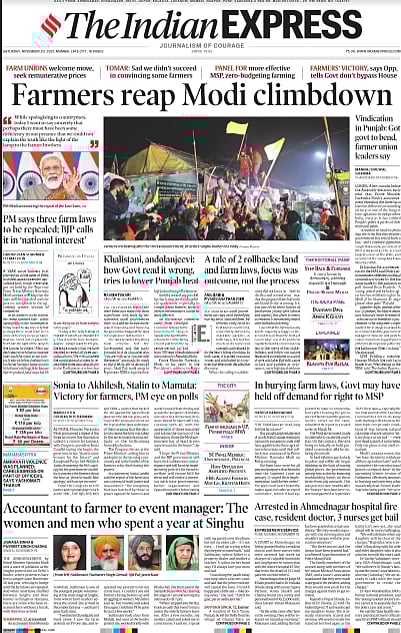
In his usual dramatic style, prime minister Narendra Modi pulled another rabbit from his topi on November 19.

After a year of ignoring the thousands of farmers protesting at the gates of the national capital, demanding the repeal of the three farm laws rammed through parliament by his government, after dismissing their agitation as nothing more than one that was instigated by "andolan jeevi", people who live for protests, he conceded. The laws are being repealed.

While the debate after the announcement has centered on the motives behind the climb-down, and the lessons all political parties can derive from the determination shown by the farmers, another question that must be asked is what lessons the media can learn from the way we covered this remarkable, and historic, civil movement.

With a media obsessively focused on “breaking news” and dramatic events, something as long lasting, and peaceful, as this protest poses a challenge precisely because it is not one, or even a series of events. It is the result of processes that include the state of agriculture and decades of frustration.

When we look back at this year, what viewers and readers are likely to recall in relation to the farmers' protest is a handful of events, such as the standoff between the Delhi police and some of the farmers on Republic Day this year, and how one group climbed the ramparts of the Red Fort in Delhi and raised a flag. Or images of traffic jams on the day the Samyukta Kisan Morcha called for a nationwide bandh.

The result of this kind of bits-and-pieces reporting is that only the spectacular, the violent, the confrontationist, remains in memory whereas the core of this remarkable movement might be erased from public memory.

What will be forgotten, because it was barely reported, was the amazing diversity represented in those who stayed the course over this year. They were women and men from several states, not just Punjab. Many came to show their solidarity. Yet many stayed on. Their stories are worth recording. A few diligent reporters, mostly outside the mainstream from independent digital platforms like Newslaundry, have done just that.

Also, early on the protesters were clear that they could not depend on mainstream media to tell their story. So, they set up their own digital website, Trolley Times.

There were so many stories to tell: the way this protest was organised, that it remained peaceful, that people were fed and housed, that medical aid was available, as this piece by Priya Ramani illustrates.

And let's not forget the women. They were not just helpers, making rotis and being in the background. They assumed leadership roles that only a few in the mainstream media noted.

Fortunately, after Modi's announcement, some in the media made an effort to provide adequate background to readers. The most notable was the November 20 edition of the Indian Express that reported not just the announcement but also provided readers with background of all aspects of the struggle.

And, of course, Ravish Kumar in his primetime programme on NDTV India, who gave us the visuals that we should always remember, including the extent to which the Delhi police went to prevent the protesters from entering the city by digging up the road, embedding spikes, and barricading them with huge containers.

It is not always easy to report on something that continues for so many months. How do you find new angles? Besides, how many media organisations are prepared to assign such movements as a legitimate beat for their reporters? I had discussed in a previous column, marking 300 days of the farmers' protest, the challenges journalists face in covering large civil society gatherings.

A similar challenge faced us decades ago when we reported on one of the longest civil society movements of recent times: the struggle against the big dams on the Narmada River and, specifically, the Sardar Sarovar Project in Gujarat.

The movement, the Narmada Bachao Andolan, was launched in 1985. It began with demanding proper rehabilitation for the people who would be affected by the dam. But in the face of refusal by the Gujarat government to even discuss this, it went on to oppose the construction of the dam.

The NBA successfully mobilised the tribal communities that would be most affected. It also asked questions about the environmental costs of the dam that would submerge many hectares of primary forests. The movement was one of the first to question developmental policies from the environmental perspective. Until then, large and grandiose projects were celebrated as great achievements in a developing country.

For the journalists covering this movement, there were many dimensions that needed to be understood. The perspective of the tribal communities who would be most affected by submergence, for instance. These were people who had lived for decades with developmental neglect such as lack of roads, medical care, education, sources of livelihood, etc. What little they could eke out from their lands and the forests was also being taken from them.

The counter story was India's need for electricity and water for irrigation. It was argued that only if projects were built on this scale could this be done and the collateral, in terms of submergence, was unavoidable.

This was a time when print dominated the media. We did not have 24/7 news channels. Hence, reporters and photographers had to tell this story. And like the farmers' protest, although there were a few dramatic events, the main story consisted of understanding and reporting on the reasons for the resistance, the extent of the impacts of the project, and the stands taken on both sides.

The movement, led by Medha Patkar and her team, did not succeed in stopping the Sardar Sarovar Dam from being built. But the protests drew international attention, and led to serious rethinking in the World Bank about funding such projects in the future.

The fact that even mainstream media houses sent out reporters and photographers to cover this protest played no small role in this. Without that kind of documentation, the movement might have been restricted to the specific areas where people had been mobilised, mostly well away from media centres.

When we look back, it is striking how many journalists followed the story over many years and their news organisations gave them the space to do so. It was an education in how the other half in this country survives. Going to those sites of submergence, seeing the conditions in which the tribal communities lived, understanding their continual struggle for basic survival was a lesson in understanding poverty and misguided developmental policies.

The tragedy is that even those villages that escaped submergence in these tribal districts, because they were on higher ground, continue to suffer neglect in terms of basic health care, education or road connectivity. In all these decades, little has been done to change this reality.

In this 2015 article, "Chronicle of a struggle retold" in the Hindu, sociologist Shiv Visvanathan beautifully encapsulates the decades of struggle by the NBA. He writes, "If you were to ask a middle class person today what the most significant act of history in India of the last 20 years is, most would say this – the rise of Narendra Modi. But to me, the most important historical event of the last two decades has been the battle over the Narmada dam."

The article is a calendar of events starting in 1961 when Jawaharlal Nehru laid the foundation stone of the Sardar Sarovar Project to December 2000, when 350 people trying to present a memorandum to the Chief Justice of India in Delhi about the project were arrested. The most memorable was the Narmada Sangharsh Yatra in December 1990, which was stopped by the Gujarat police at Ferkuva on the border of Madhya Pradesh and Gujarat. For those, including journalists, who want to get a glimpse of this long and peaceful civil society movement, Visvanathan's article is a vivid summary.

The lands and the forests of the tribals who lived on the banks of the Narmada are gone. The benefits of the irrigation and electricity generated by the project have not accrued to them. But their story has been documented – in films, in books, in newspaper articles.

The farmers who are protesting are not leaving yet. But their story, and that of their movement, awaits similar documentation. Doing this is not being partisan. It is what we ought to be doing. Recording history as it takes place, so that future generations will know why and how thousands of women and men, who grow the food we eat, chose to sit it out on New Delhi's borders in the heat, in the rain, in the cold for a year.


Monday, October 18, 2021

As we celebrate the Maria Ressas of the world, let's not forget the Raman Kashyaps

 Broken News

Published in Newslaundry on October 14, 2021

Link: https://www.newslaundry.com/2021/10/14/as-we-celebrate-the-maria-ressas-of-the-world-lets-not-forget-the-raman-kashyaps


On October 3, Raman Kashyap, a journalist not known outside the place where he worked, was killed. He was covering a farmers' protest in Lakhimpur Kheri. He was one of the eight people killed when a car rammed into the protesters and in the violence that followed.

A week later, on October 8, the Nobel Prize Committee announced the recipients of this year's Peace Prize: two well-known journalists from the Philippines and Russia. Both have been recognised for their courageous journalism in their respective countries. Both have fallen foul of their governments. Both are determined to continue doing what they have been doing for years. As the chair of the Norwegian Nobel Committee said when announcing the award, they were chosen not just for their courage but also as “representatives of all journalists who stand up for this ideal in a world in which democracy and freedom of the press face increasingly adverse conditions.”

Maria Ressa and Dimitry Muratov's selection for the Nobel Peace Prize has sent out a strong message of encouragement to other journalists like them around the world, but also to governments who continue to deny press freedom that their actions are being noted.

There is much we can learn from the work of both these journalists. Apart from their courage and their persistence in doing what they see as their primary duty as journalists, to be unafraid to investigate and report the wrongdoings of the powerful, their life and work also illustrate the importance of building institutions with people who can make this kind of work possible.

Maria Ressa is one of the founders of the website Rappler that has taken on the Philippines government led by president Eduardo Duterte. Dimitry Muratov established Noyava Gazeta in 1993 and continues to write fearlessly despite living under the regime of Vladimir Putin that permits little by way of press freedom.

But even as we celebrate the Nobel Peace Prize for Ressa and Muratov, let's pause for a moment and think about 35-year-old Raman Kashyap. He was a freelance journalist who sent reports to a local TV channel, Sadhna TV. According to Wikipedia, Sadhna TV is "an Indian spiritual television network owned and operated by Sadhna Group. It was launched on 18 April 2003."

Kashyap had joined the channel just two months ago according to his family. His other job was as a schoolteacher. He was married with two children aged 11 and three. He earned around Rs 500 for every story he filed, if it was used.

There are thousands of Raman Kashyaps who are a part of the media scene in India. But they are hardly ever recognised or even acknowledged. Kashyap has gained more fame in his death than he ever would have had he lived and continued to work as a district journalist.

In fact, his death throws a light on this army of underpaid and even unpaid news-gatherers that are so vital to the news business.

Sevanti Ninan, in her seminal book Headlines from the Heartland (Sage, 2007) recorded the growth of this hidden army of news-gatherers. They are not even designated as journalists. Most of them are not trained. And many do other jobs and fill in as journalists, or stringers, when required.

This process of localisation of news, which began in the mid-1980s, really took off in the 1990s. By then private television channels had entered the media scene. They swept up a large chunk of advertising that would have gone to print media.

This is when regional newspapers, starting with Eenadu in Andhra Pradesh followed by big Hindi newspapers like Dainik Jagran, Dainik Bhaskar and Hindustan, began the process of localisation. Beginning with introducing pages that accommodated district news, they even went on to have district editions. The aim was to sweep up local advertising as well as readership. This was a strategy to leverage their reach into semi-urban and rural areas with the big consumer products companies that wanted to reach these markets.

The formula worked as was evident in the growing circulation of these papers. But alongside, this also spawned a new breed of journalist. These men were tasked not just to report, but also to bring in advertising. Payment was by way of commission based on the amount of advertising they brought in. The reporting was mostly unpaid. But the person got a visiting card that identified him as a representative of a media group. That was currency in these rural settings; it gave the person status and some legitimacy.

According to Ninan, "Without exception every localisation drive in India's Hindi heartland was riding on the willing backs of a host of largely unpaid stringers, filing quantities of miscellaneous news from their immediate neighbourhood." (page 116) She notes that newspapers like Dainik Jagran or Hindustan would have, at any time, from 200 to 1000 stringers in a state. Ninan's book is replete with many fascinating details about the localisation of news and is worth revisiting as we think of journalists like Kashyap.

Only around 2005 did these newspapers introduce some form of gate keeping, by authenticating the information coming in from their stringers. Given the caste and political hierarchies that operate in a rural setting, how would one know for sure that the information was legitimate? An important step taken was to relieve stringers of the task of collecting advertising, thus removing the very real possibility of conflict of interest.

The process of newsgathering by part-time journalists that began with newspapers continued with television channels, especially the smaller ones. And now, with the advent of the internet and social media, anyone with a smartphone can become a journalist. To have eyes and ears on the ground with minimal additional investment is something that most media houses would welcome. And that is what they do.

But when one such journalist lands in trouble, or is injured, or even killed, there is no one who comes to his or her aid. As Jitendra Singh, another local journalist from Lakhimpur Kheri tells Shivangi Saxena in this short video posted by Newslaundry on Twitter, no one cares. Even the events of Lakhimpur Kheri would have passed without creating such a stir had the video showing the men being mowed down, shot by a local journalist, not surfaced within a couple of days. It was delayed, as Singh points out, because the internet was shut down and those who had footage could not share it until a couple of days later. He says, "Big Media came after the violence. There wouldn't have been any proof of the violence had we not been there."

That visual proof that these local, poorly paid journalists provide has proven repeatedly to be the essential building block of a larger story. The most recent of these is Lakhimpur Kheri but there are many like this from the past. The reach of Big Media, as Jitendra Singh calls it, would be greatly reduced if these men were not feeding the news machine.

From the perspective of the big media houses, there is always the question of credibility and authenticity of the reports that come, by way of district stringers. But there are ways to double check. The inputs from these stringers provide a lead, much as news agencies with reporters in more places than even the largest newspaper chain have always done. This is what media houses need to acknowledge and back grassroots news-gatherers, many of whom take considerable risks while doing their jobs.